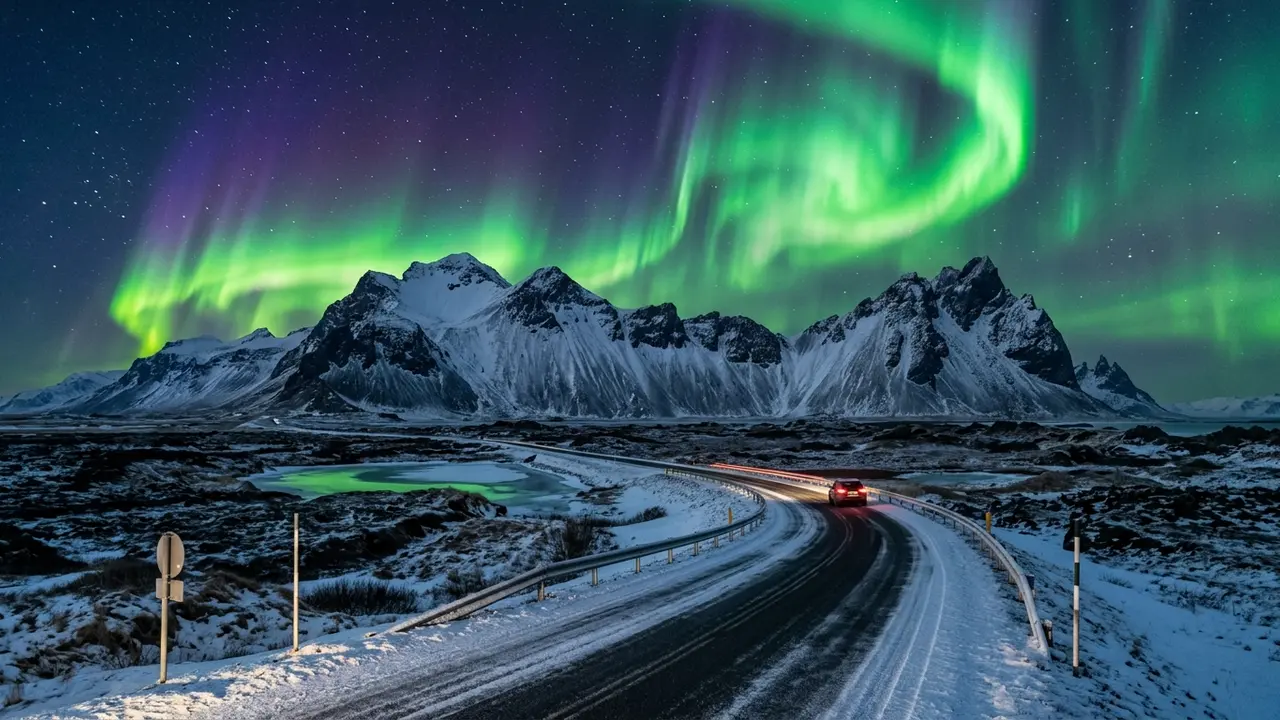

When to go: Iceland's aurora season and the best months
Aurora season in Iceland runs from early September through late March, with November through January delivering the longest dark stretch of the year but also the heaviest cloud cover, and October and February offering a better balance of darkness and clearer skies[1].
- November–January: longest nights, but Iceland's cloudiest stretch
- October and February: less darkness, meaningfully better weather odds
- September and March: the equinox months, when geomagnetic activity tends to run higher
2026 adds another factor: Solar Cycle 25 peaked in October 2024 and is now in its declining phase, though forecasters still expect occasional strong displays through the year, worth keeping in mind whichever month you end up booking.
If you want one answer: October is the safest all-around pick for a first trip, with March as the underrated alternative once the days start lengthening again. The Iceland northern lights destination guide has a full month-by-month breakdown of weather and daylight hours.
Iceland's latitude advantage: the Kp index explained
The Kp index is a 0-to-9 scale that measures the strength of geomagnetic disturbance in Earth's magnetic field, recalculated every three hours from readings at magnetometer stations worldwide[3]. The higher the number, the further from the poles the aurora typically reaches, and the more intense a given display tends to look.
Iceland's advantage is geography, not luck: sitting at 64–66°N places the entire country beneath the auroral oval, the band where the aurora concentrates, which is why a Kp of 2 or 3 is often enough for a visible display from any dark spot in the country[1]. Most mid-latitude locations in Europe and North America need Kp 5 or higher before anything shows up at all. That gap is the single biggest reason Iceland ranks among the most forgiving countries in the world for a first aurora trip — read the full Kp index explainer before you start checking forecasts every night.
Featured · Destination
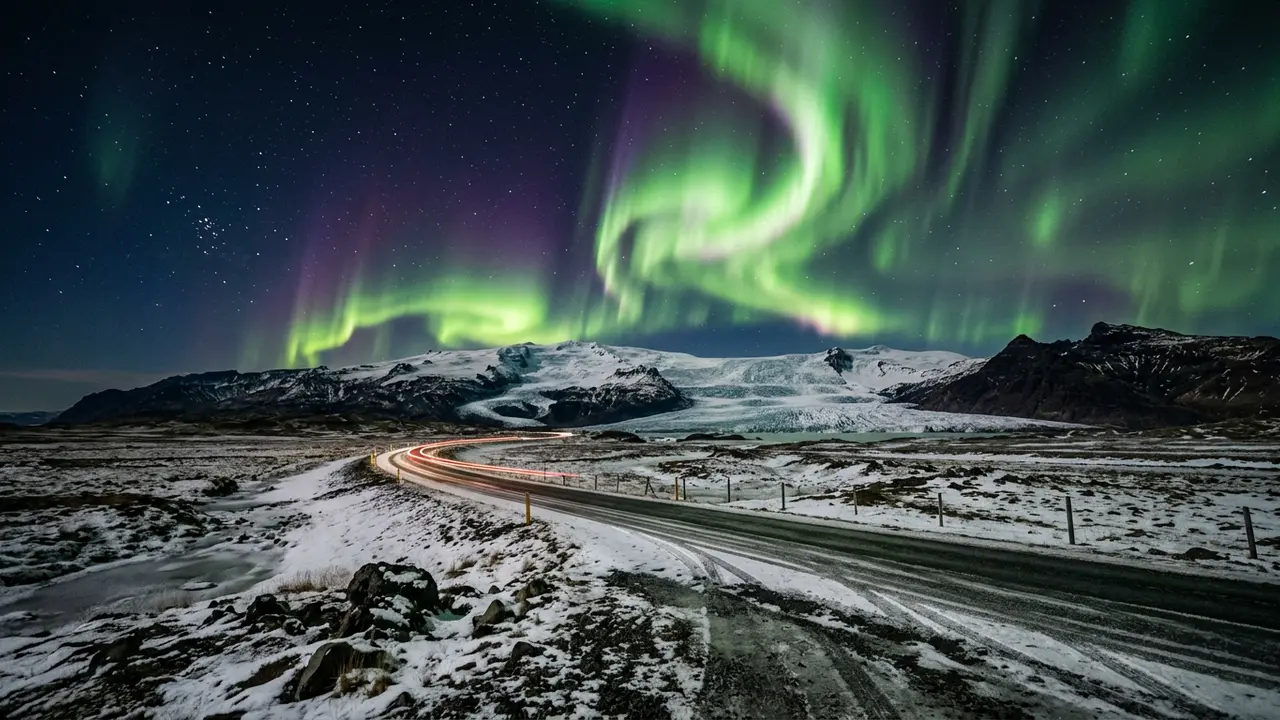
Northern Lights in Iceland
Iceland's whole-country aurora guide: best regions to base in, aurora season Sep–Mar, ice caves, winter driving reality, and where cloud cover ends every plan.
None of this replaces the other two ingredients: a good aurora night still needs clear skies and real darkness on top of a decent Kp reading, and a perfect forecast under thick cloud produces nothing. For the physics behind why any of this happens at all, this explainer on the aurora's solar-wind origins walks through the solar wind and magnetosphere from the Sun to the glow overhead.
Your odds: how likely are you to see the northern lights?
There is no way to guarantee a sighting; the northern lights depend on geomagnetic activity, weather, and where the aurora happens to be strongest on a given night. What you can control is how many nights you give yourself. Iceland-based operators consistently recommend the same range: plan for 3 to 5 nights in the country if seeing the aurora matters to your trip, rather than treating it as a bonus on a single overnight stop[1]. Cloud cover, not geomagnetic activity, is usually the limiting factor: a perfect Kp forecast under an overcast sky produces nothing, while a modest Kp reading on a clear night can still deliver a strong display.
3–5 nights
2026 still has something going for it. Solar Cycle 25 peaked in October 2024 and is now in its declining phase, but forecasters still expect occasional strong displays through 2026[7]. Combined with Iceland's latitude, which needs only modest geomagnetic activity to produce a visible aurora, it remains a reasonable year to book rather than wait for something better.
Timing within the night matters too: aurora activity in Iceland tends to peak between 10 PM and 2 AM local time[4], so plan your evening around that window rather than heading out right after dinner and giving up by ten.
Reykjavik city versus driving to dark skies
From the streets of central Reykjavik, light pollution raises the bar significantly: you typically need Kp 6 or higher for a reliable sighting, and driving just 20 to 30 minutes away from the city noticeably improves your chances even on a modest Kp night[1].
Recommended tours
Tours are selected for quality, not commission. I earn a small fee if you book — at no extra cost to you.

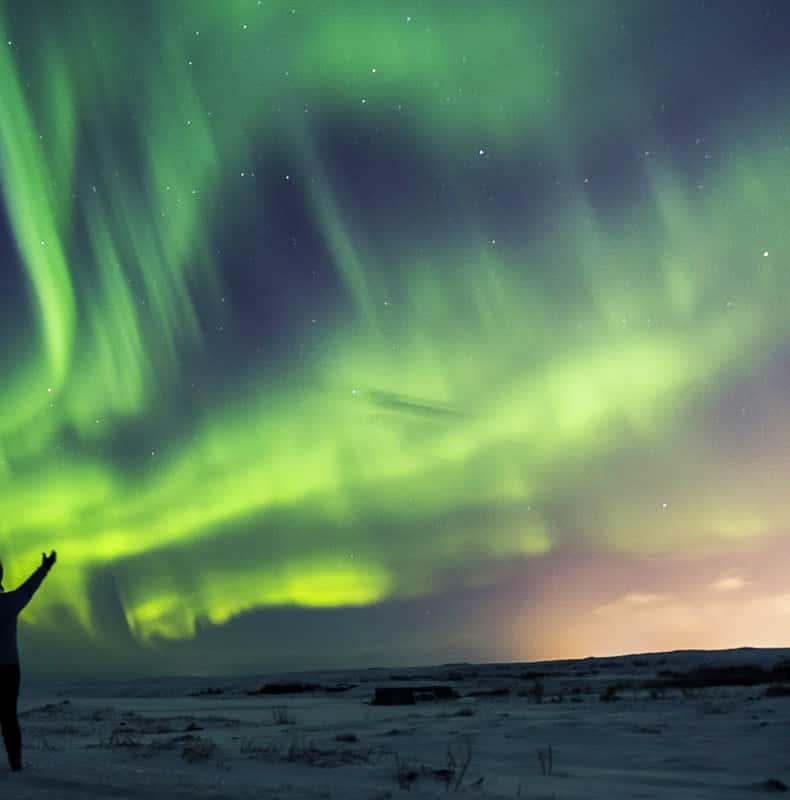
Where you go from there depends on how much time and driving you want to commit:
- Snæfellsnes Peninsula: dramatic coastal scenery as a backdrop, a manageable drive west of Reykjavik
- South Coast: easy Ring Road access with a good spread of dark pull-outs
- Westfjords: remote and genuinely dark, but a longer drive to reach
- North Iceland (Akureyri): far enough from the capital's glow to matter, with the same strong latitude
Most first-time visitors base themselves in Reykjavik and take short evening drives out on clear nights, checking a cloud-cover map before committing to a direction. If maximizing odds matters more than convenience, a few nights in North Iceland or the Westfjords, away from any city glow at all, is the stronger bet.
Self-drive or guided tour: costs and winter driving safety
A guided tour is not required to see the northern lights in Iceland; plenty of visitors rent a car, check the forecast, and drive out on their own. What a guide adds is real-time routing: professional operators track cloud cover and Kp forecasts at the same time and drive toward whichever direction is actually clear that night, which matters more than it sounds on a trip with only a handful of usable evenings.
Costs vary widely depending on the approach. Local tours from Reykjavik span everything from a shared minibus outing to a private guide, and prices swing sharply by group size, season, and operator, so check current listings directly rather than budgeting off a single figure. Multi-day tour packages that bundle flights, accommodation, and several aurora attempts run well into four and five figures per person depending on the operator, season, and itinerary length. Self-driving is generally cheaper once you factor out the guide fee, but it shifts all the routing and risk decisions onto you.
That risk is real. Winter driving in Iceland means darkness for most of the day, ice on unmarked roads, and a specific, documented hazard: drivers looking up at the aurora instead of at the road ahead of them, which is why a 4WD or AWD vehicle with proper winter tires is the minimum for driving after dark in winter conditions; studded tires are legally permitted from November 1 to mid-April but not required[6]. If the aurora appears while you are driving, the right move is to pull completely off the road, kill the headlights, and watch from a stationary position, not from behind the wheel.
| Approach | What it costs | Best for |
|---|---|---|
| Self-drive | Rental car, fuel, and lodging, no guide fee | Confident winter drivers, flexible schedules |
| Local guided tour | Varies by group size and operator — check current listings | First-timers, no rental car needed |
| Multi-day tour package | Varies by operator — check current listings | Hands-off planning, several aurora attempts built in |
Forecasts, apps, and planning your trip
The Icelandic Meteorological Office runs the aurora forecast most locals and guides actually check: en.vedur.is combines a predicted Kp number with a real-time cloud-cover map, updated every three hours[3]. That update cadence matters; checking once in the morning tells you almost nothing about what the sky will do at 11 PM.
Read next · Guide
Best Aurora Forecast Apps for Chasing the Northern Lights
My Aurora Forecast, SpaceWeatherLive, Glendale, Hello Aurora, and AuroraWatch UK compared: what each shows, what's free, and who each app actually suits best.
A handful of other tools are worth having alongside it:
- Aurora Reykjavik and Aurora Forecast Iceland: apps built specifically for Iceland, with live updates
- NOAA's Space Weather Prediction Center: useful for the broader 3-day solar wind outlook, though less Iceland-specific
- Fire & Iceland: a smaller independent forecast worth cross-checking against vedur.is
No single source is fully reliable this far out; compare at least two, and trust the 3-hour update over anything predicted more than a day ahead. If you also want to come home with a photograph rather than just a memory, the best aurora forecast apps guide covers the tools in more depth, and how to photograph the northern lights covers the camera settings you will need once the display actually starts.