
Why Iceland's winter cold is wet, not dry
Check the forecast for Reykjavík in February and the numbers look almost mild: -5°C to 5°C (23°F to 41°F) on the south coast, closer to 0°C most days. Those readings are deceiving. The Atlantic keeps Iceland's air far warmer than continental cold pockets like Fairbanks or interior Lapland, where extended stretches of brutally low temperatures are simply a normal part of winter. Iceland trades that extreme cold for something that is, in its own way, harder to dress for: wind, damp air, and precipitation that switches between rain, sleet, and snow within a single afternoon.
Wind is the real threat. Iceland's winter gusts regularly reach 24 mph, and coastal storms push that past 40 mph; monthly precipitation averages 3 to 4 inches, arriving as rain, sleet, and snow, sometimes all three in the same outing[1]. None of that shows up on a phone's temperature app, but it is the difference between a survivable evening on a lava field and a genuinely miserable one. Iceland even runs a color-coded storm warning system, yellow through red, because wind alone closes roads and cancels ferries.
Compare that to Fairbanks, where the cold itself is the danger and frostbite can set in within minutes at -40°F. In Iceland the mechanism is different: damp air soaks into insulation, and wind strips heat from wet skin faster than dry cold ever could. Hypothermia from wet clothing is the bigger risk here on any given night, not frostbite. A parka rated for a ski resort will keep you warm; it will not keep you dry, and in Iceland, dry is what actually matters.
40+ mph
That reordering of priorities is the whole point of an Iceland winter packing list. A Fairbanks list leads with fill power and mitten ratings; this one leads with waterproof membranes, glove rotation, and the assumption that everything you own will get at least a little wet.
The layering system: base, mid, and a shell that actually blocks water
Three layers, same as anywhere cold, but the emphasis shifts. In Fairbanks you double up on mid-layer insulation and treat the shell as a windbreak. In Iceland the outer shell does more of the work, because it is fighting off actual precipitation, not just wind.
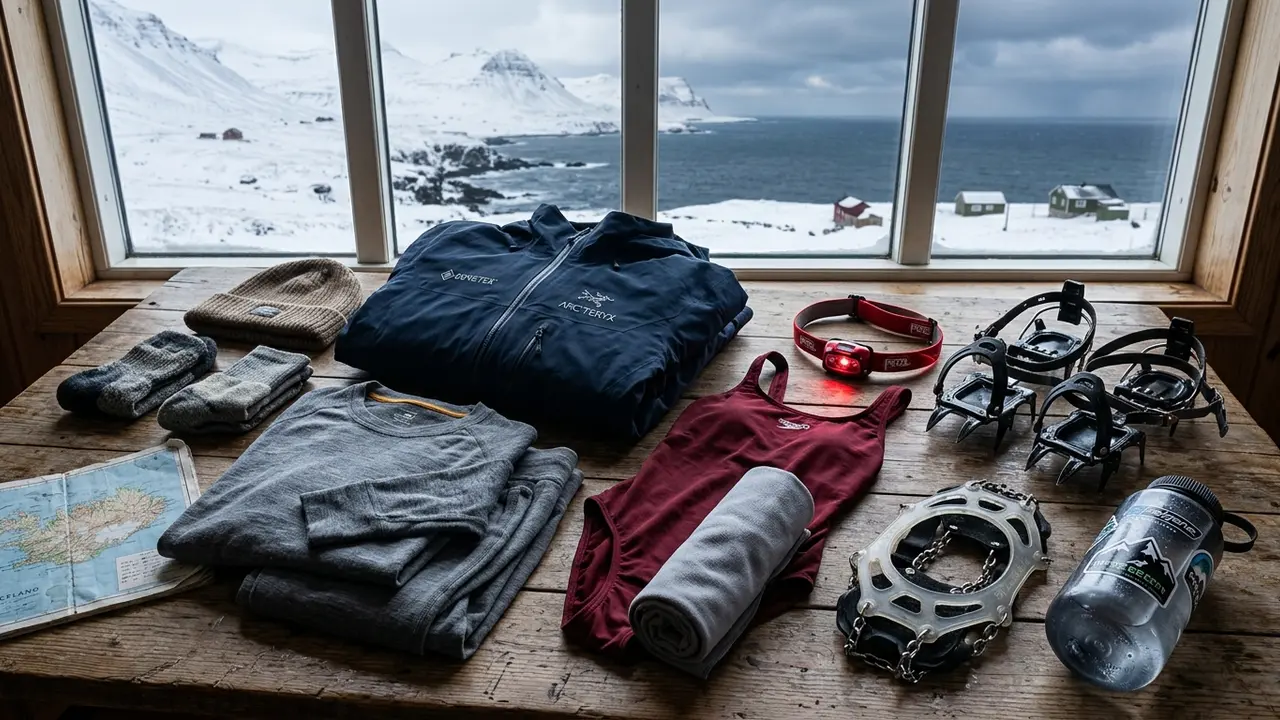
Your base layer should be midweight merino wool or a synthetic wicking fabric, something that moves sweat away from skin during an active day of glacier hiking or ice cave scrambling, not just standing still. Merino is the safer default because it keeps some insulating value even when it gets damp, which happens more often here than you would expect on a trip built around rain, sleet, and sea spray.
| What matters most | Iceland (damp-coastal cold) | Fairbanks (dry cold) |
|---|---|---|
| Primary threat | Wind chill and wet insulation | Direct frostbite from air temperature |
| Outer shell job | Block rain and wind, breathable membrane | Block wind, insulation does the warming |
| Base layer emphasis | Moisture management during activity | Moisture management while standing still |
| Typical shell rating | 0°C (32°F) Gore-Tex shell is enough | -40°F expedition-rated parka needed |
The outer shell is where Iceland's packing list actually differs from a generic cold-weather kit. Look for a jacket built from a breathable waterproof membrane, Gore-Tex or eVent, rather than a simple polyurethane coating. The distinction matters: a PU-coated jacket blocks rain but traps your own sweat inside, so a hard uphill scramble toward an ice cave entrance can leave you as wet from the inside as you would have been without the jacket at all[2]. Check that the seams are sealed, not just taped at the main panels, and look for a minimum 10K water-resistance rating.
Skip the expedition-weight parka. Iceland's temperatures rarely justify 650-fill down and a foot of loft; one lightweight-to-midweight insulating layer is enough:
- A 200 to 300-weight fleece or wool mid-layer that compresses under the shell without bulk
- Synthetic insulation over down if you expect heavy precipitation, since down collapses and stops warming once wet
- A softshell option for active days, ice cave approach hikes and glacier walks, where a hardshell makes you overheat
The net effect: your Iceland kit ends up lighter and less bulky than a Fairbanks kit, but the shell has to work harder.
Hands, feet, and head: plan to change everything twice a day
Aurora hunting in Iceland is not the stand-still-for-six-hours discipline it is in Fairbanks. You might drive to a dark pull-out on the Ring Road, or you might be walking a glacier approach trail with a headlamp between shots. Aurora is visible here from September through March, with the darkest, longest windows falling between November and February[3], and a fair share of those nights involve at least some hiking. Your extremity kit has to support both standing still and moving.
Gloves, not mittens, are the right call in Iceland's milder range. Mittens make sense at Fairbanks-level cold; at -5°C to 5°C, gloves give you the dexterity to work a camera dial or scramble over ice without losing meaningful warmth. They need to be windproof, waterproof, and ideally touchscreen-compatible, because you will be checking a phone map more than you expect. Bring two to three pairs: a damp glove starts failing within 15 to 20 minutes in this climate, and drying one pair overnight while you wear another is the only way to stay ahead of it. Chemical hand warmers help but matter less here than in extreme dry cold; save them for nights you know you will be stationary.
Feet follow the same logic. Waterproof, insulated boots rated to at least -10°C with real traction are the baseline, and a two-sock system, a thin wicking liner under a cushioned merino ski sock, keeps feet dry longer than any single pair. Bring extra socks. Change them the moment they feel damp, not once they are visibly wet; a slightly damp sock left on for another hour is how people end up with cold feet three hours into a drive.
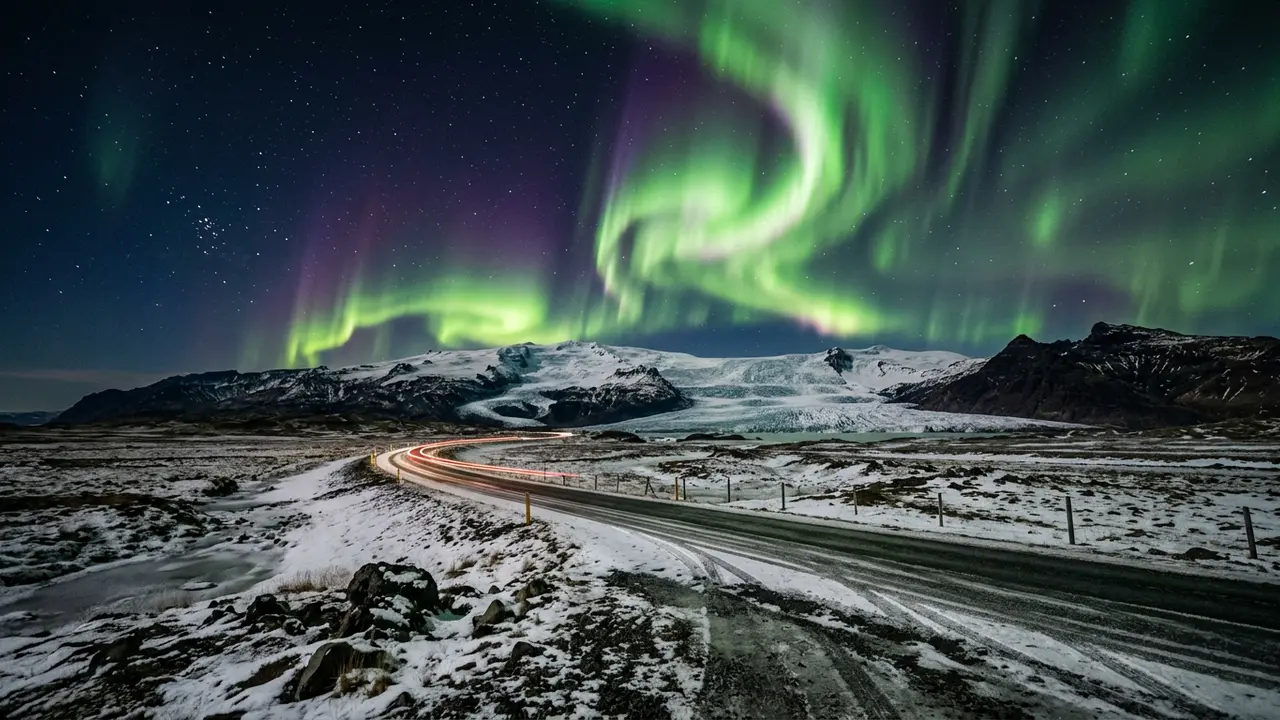
Featured · Destination
Northern Lights in Iceland
Iceland's whole-country aurora guide: best regions to base in, aurora season Sep–Mar, ice caves, winter driving reality, and where cloud cover ends every plan.
For your head, a wool beanie with ear coverage handles most nights. Add a merino or fleece neck gaiter for wind protection, and pack a balaclava even if you do not expect to need it: on a 40 mph gust night, you will be glad it is in your bag. If you wear glasses, bring a clear or amber-tinted pair rather than dark sunglasses, since darker lenses cut into the already-limited light of an aurora-hunting night.
Ice caves and glaciers: crampons are not optional
If an ice cave or a glacier walk is on your itinerary (and it should be, Vatnajökull's blue-ice caves are one of the best reasons to visit Iceland in winter), your regular hiking boots will not cut it. Tour operators provide crampons and safety gear, helmet and harness included, for the ice itself, but your boots need to be stiff enough to take a crampon strap; soft-soled boots flex too much and the crampon slips[4].
Everyday walking is a separate problem from ice cave crampons, and a lighter solution covers it. Ice spikes, small metal studs that strap over your regular boot sole, are enough for Reykjavík's sidewalks, glacier approach trails, and any icy path where you are not actually roped up on a glacier. Black ice on pavement and on unheated stretches of the Ring Road is a serious, frequently underestimated hazard; pack a pair even if your itinerary looks entirely low-key.
For the roads themselves, winter driving in Iceland comes with its own rules around 4x4 requirements and closure alerts. See Getting Around Iceland in Winter for what you actually need to know before renting a car. The short version for packing purposes: bring the ice spikes, and do not assume a rental car's tires make crampons for your feet unnecessary.
Camera gear for aurora nights: tripod, batteries, and the red-light rule
Aurora photography needs exposures of ten seconds or longer, which means a handheld shot is a blurred shot, full stop. Bring a tripod that can genuinely hold still in wind, not a travel tripod bought for daytime landscapes. Carbon fiber is lighter to carry and less painfully cold to touch than aluminum at midnight. Keep the legs short and wide rather than fully extended: a lower, wider stance survives a gust that would topple a tall, narrow one, and hang a bag or a water bottle from the center column as ballast if the wind picks up.
Cold drains camera batteries faster than you plan for, and Iceland's damp cold is no gentler on them than dry cold is. Carry at least two spares and keep them in an inner jacket pocket, close to your body, rather than in the camera bag. Never breathe on the lens to clear condensation; the moisture in your breath freezes onto the glass almost instantly.
A headlamp with a genuine red-light mode, not a red filter clipped over a white LED, is the one piece of gear that photographers underrate before their first trip. Human night vision runs on rod cells that are sensitive to blue and green light but largely blind to red, so a white headlamp erases your dark adaptation in seconds and costs you 15 to 30 minutes to get it back. A dedicated red LED lets you check settings, change lenses, and pick a path through an ice cave without ruining either your eyes or your exposure[5]. For technique once the gear is sorted, the Northern Lights Photography Guide covers composition and exposure settings, and Iceland Aurora Photography Gear goes deeper on lens choice and camera bodies for this specific landscape.
Read next · Article
Stargazing Gear for Beginners: Binoculars to Telescopes
New to stargazing gear? This guide breaks down binoculars, telescopes, and smart telescopes, so you know what to buy first and what to skip for right now.
The Iceland-only extras: swimwear, sunscreen, and what to leave home
Pack a swimsuit. It feels like an odd instruction for an arctic packing list, but Iceland's geothermal pools, Blue Lagoon and Sky Lagoon chief among them, run year-round, with thermal water sitting at 37 to 39°C (98-102°F) even while snow falls on the surface[6]. Soaking in that heat after a day standing on a glacier is one of the best reasons to travel here in winter, and both venues rent towels, so the swimsuit is the one thing you actually need to remember. Smaller local pools and hot springs scattered around the country often do not rent towels, so bring your own if you are chasing the quieter spots. Sunscreen is not a summer-only item either: snow and water both reflect UV, and an overcast Icelandic sky filters less of it than people assume.
Leave cotton at home entirely. Cotton absorbs moisture and holds it against your skin instead of moving it away, which is the opposite of what you want in a climate built on dampness rather than dry cold[7]. That rules out:
Recommended tours
Tours are selected for quality, not commission. I earn a small fee if you book — at no extra cost to you.
- Cotton socks, or wool-cotton blends with meaningful cotton content
- Cotton or cotton-blend base layers and thermal underwear
- Denim, which soaks through and stays wet for hours
- A casual city winter coat rated for above-freezing commuting, not coastal storms
For everything else worth doing between aurora nights: glacier hikes, Golden Circle stops, and the hot springs beyond the two famous lagoons, the Things to Do in Iceland Beyond the Northern Lights guide covers the daytime side of the trip this packing list is built to support.