
When is aurora season in Abisko, and when's the best time to go?
This FAQ complements the full Abisko Stargazing destination guide, working through the specific numbers most visitors want before booking: season, cost, how far ahead to reserve, and how reliable the weather really is.
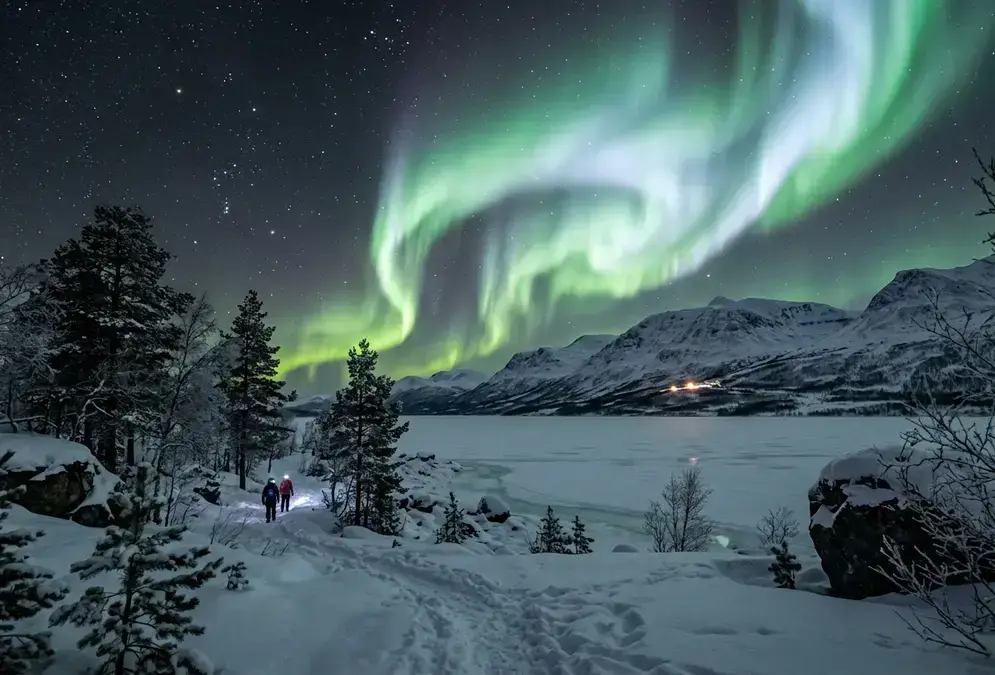
Aurora season runs from late August or early September through April, with the Swedish Tourist Association naming mid-November through mid-March as the highest-chance stretch of the year. By 25 May the sun stops setting entirely, and Aurora Sky Station switches from night viewing to guided daytime summit hikes until dark returns in late summer.[1]
Two numbers matter more than the calendar. First, magnetic latitude: Abisko has a magnetic latitude of 65.9°N geomagnetic, high enough that aurora tends to become visible at a lower Kp index threshold than most mid-latitude locations need. There's no single agreed figure, aggregator sites disagree between roughly Kp 2 and Kp 3 for Abisko's latitude, so treat any specific number as approximate rather than a guarantee; September and October, around the autumn equinox, add a documented lift in geomagnetic activity on top of that already-low threshold, combining long darkness with relatively mild weather.[2] That's why guides here flag the equinox weeks specifically rather than just pointing at winter.
Kp 2-3
None of that replaces a same-week forecast. Reading Kp values correctly, and knowing when a 3 at Abisko's latitude beats a 5 somewhere farther south, is worth understanding before you build a trip around a single number. The what that Kp number actually tells you guide covers that mechanic in full rather than repeating it here.
If you only take one thing from this section: mid-November through mid-March is the safe recommendation, but a well-timed September or October trip trades some cold for real advantages.
How much does stargazing in Abisko cost?
Abisko itself is inexpensive to look at the sky from. Abisko National Park charges no entry fee, and standing outside your accommodation on a clear night costs nothing beyond what you're already paying to be there.
The paid layer is what gets you above the valley cloud and light spill. Guided northern lights tours out of Abisko and the wider area typically run $100 to $200 USD per person, with the range driven by what's included: photography gear and instruction, a hot dinner, extended chase time by minibus, or a private small-group format instead of a shared bus.[3] Entry to the Aurora Sky Station itself, the region's marquee paid attraction, is priced by season and how far ahead you book; exact per-person rates shift year to year, so confirm the current figure directly on STF's booking page rather than trusting a number printed elsewhere.
Rough budget categories to plan around:
- Free: watching from a dark spot in the national park or near your lodge
- Low-cost, self-guided: an Aurora Sky Station chairlift ticket with no guide attached
- $100-200 per person[3]: a guided minibus or small-group aurora tour, usually including chase-driving toward whichever direction has clear sky
- Premium: private guides, photography-focused sessions, or multi-night packages bundled with a lodge
Featured · Destination
Abisko Stargazing
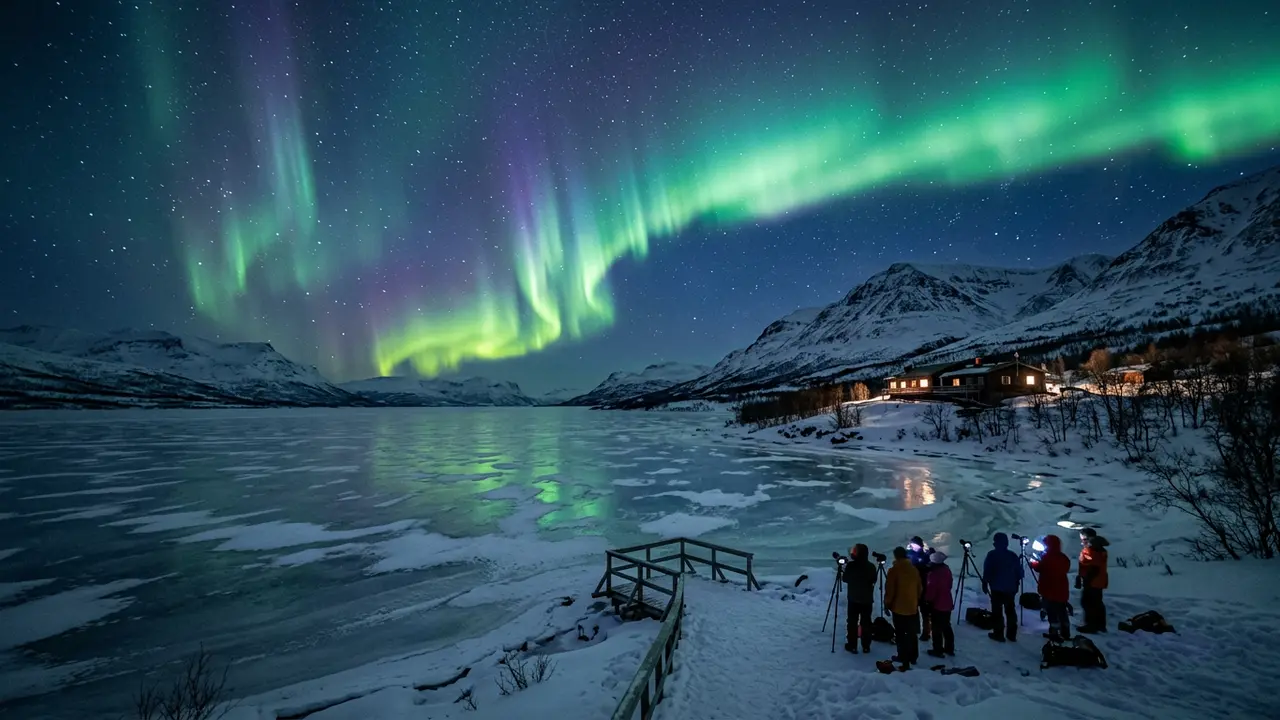
Abisko's rain-shadow microclimate keeps skies clear when nearby Arctic spots cloud over. Aurora season, the Sky Station, ICEHOTEL, and getting there by train.
Whichever category you pick, book before the trip. Weather-dependent tours in a destination this small sell through fast on any night the forecast looks promising.
Do you need to book Aurora Sky Station in advance?
Yes, and earlier than most first-time visitors expect. Reaching the Aurora Sky Station requires a chairlift ride of about 30 minutes up Mount Njulla (Nuolja), inside Abisko National Park, and that chairlift is the only practical way up once the trail is under snow.[4]
The Northern Lights Night activity at the top is capped at 40 spots per session.[5] That's not a marketing figure; it's a physical limit on the viewing terrace and chairlift capacity. On any night with a favorable forecast, mid-November through mid-March especially, sessions sell out days in advance. Booking the morning of, or showing up at the lower station hoping for a same-day seat, is a real way to spend a clear night watching from the valley floor instead of above it.
Read next · Tour
Aurora Sky Station Abisko Night Visit
Ride the chairlift above Abisko's treeline to the Aurora Sky Station for a real shot at the northern lights. Only 40 spots nightly, so book direct through STF.
Practical booking notes:
- Book directly through STF or the Aurora Sky Station's own site, not a third-party reseller, so cancellation and rebooking terms stay clear if weather forces a change
- Favorable multi-day forecasts fill sessions fastest; a promising Kp forecast a week out is the week to lock in dates, not wait and hope for a same-day opening
- Guided tours leaving from Kiruna or elsewhere in the region run on their own separate booking systems and capacity limits, so check each operator directly rather than assuming Sky Station rules apply everywhere
How reliable is Abisko's weather, and is it clearer than Tromsø or Kiruna?
More reliable than most of Arctic Scandinavia, and there's a real mechanism behind it, not just local pride. Abisko has the driest climate in Sweden, well below what falls on the Norwegian coast or even other parts of Swedish Lapland. The precise rainfall figures behind that claim, sourced from Sweden's meteorological institute, are covered in Abisko's Clear-Sky Microclimate Explained.
The reason is the rain shadow, known locally as the 'Blue Hole' effect: moist air blowing in from the Arctic Ocean hits the mountain range along the Norway-Sweden border and drops most of its moisture there, often leaving the sky over Abisko clear even when Tromsø or the coastal fjords are socked in.[6] It's a documented meteorological pattern, tracked over decades of continuous weather records, not folklore passed between tour guides.
What it isn't: a guarantee, or a hard percentage advantage over Tromsø or Kiruna you can bank a trip on. No published dataset puts a specific clear-night percentage on Abisko relative to its neighbors, and any exact figure you see quoted elsewhere is worth treating with some skepticism. What's real is the mechanism itself and the century of low-precipitation records behind it. Check a proper short-range forecast the same day regardless. The which apps are actually worth checking worth using for that final go or no-go call are covered separately, since a strong Kp forecast means nothing on a night with total cloud cover.
What time of night should you look, and how many nights should you plan?
Many aurora guides recommend 22:00 to 02:00 local time as the single best nightly window, bracketing magnetic midnight, the point when the auroral oval tends to sit most directly overhead rather than displaced toward one horizon; NOAA describes substorm activity commonly peaking in this late-evening stretch, though it doesn't give Abisko-specific clock times.[7] Activity can happen outside that window, and a strong geomagnetic storm doesn't respect a clock, but if you can only commit to a few hours outside in the cold, that's the block to protect.
Nights, not hours, are the bigger planning variable. Aurora is not scheduled, and cloud cover is the single biggest reason a clear forecast still produces nothing to see. A one-night stopover gives you a single roll of the dice against both weather and solar activity lining up. Three to four nights gives real insurance: enough that a stretch of overcast on one or two evenings doesn't sink the whole trip. For the fuller probability breakdown by trip length, see How Many Days in Abisko for Northern Lights?
A practical routine for each night:
- Check the same-day cloud forecast in the late afternoon, not just the Kp forecast
- Be at your viewing spot, whether that's the Sky Station terrace or a dark pullout near the lake, by 22:00
- Give your eyes 15 minutes away from any light source before deciding nothing is happening
- Stay through 02:00 on nights with a promising Kp reading, since substorms often peak later than expected
Aurora is not scheduled, and cloud cover is the single biggest reason a clear forecast still produces nothing to see.
Getting up the mountain: chairlift, altitude, and what to bring
Once you're booked, the physical logistics are simple, if cold. From Abisko Turiststation, the chairlift ride to Aurora Sky Station takes about 30 minutes, climbing well above the treeline before the terrain opens into a wide, unobstructed view across Lake Torneträsk and the surrounding fells.[4]
Dress for standing still, not walking. Layering matters more than any single warm-enough jacket: a moisture-wicking base layer, an insulating mid layer, and a windproof, waterproof outer shell, with insulated boots and mittens rather than gloves alone. The station has a cafe and a fireplace if you need to warm up between checks outside, but the viewing terrace is open-air, and the wind near the summit cuts harder than it does down in the valley.
Recommended tours
Tours are selected for quality, not commission. I earn a small fee if you book — at no extra cost to you.


A few things worth confirming before you go up:
- Chairlift operating hours shift with the season, so check the current schedule rather than assuming a fixed time
- The station occasionally closes the summit terrace in genuinely severe wind, independent of aurora conditions
- If you're staying near the chairlift base rather than in Kiruna, Best Aurora Lodges in Abisko and Kiruna breaks down which properties put you closest to the first lift up
None of this requires special fitness. The chairlift does the climbing. Bring layers, bring patience for a forecast that can shift within a day, and build in enough nights that one cloudy evening doesn't define the trip.