Bryce Canyon's Winter Cold Is Elevation Cold, Not Deep-Arctic Cold
Bryce Canyon's main park area sits at about 8,000 feet[1], with some monitoring points along the rim running higher still. That elevation, not any Arctic weather system, is why a clear December night on the rim runs colder than a Utah desert winter has any right to feel: thinner air holds less heat once the sun goes down, so temperatures drop fast and stay down until well after sunrise.
This is not a deep-Arctic packing list, though. Bryce's winter nights don't run into the extended sub-zero stretches that shape gear lists for aurora destinations further north, the kind of cold that demands a two-glove system and a battery-warming ritual. What you're packing for here is a real, biting high-elevation cold, cold enough to demand genuine layers and good boots, not a survival-grade kit built for negative-30s.
8,000 ft
December through February is the coldest stretch of the year at Bryce, though exactly which month gets the most snow varies year to year[2]. Weather aggregators disagree with each other by five to ten degrees on the park's average December and January lows, so treat any single precise figure you find online with some skepticism. What matters more than the exact number on a thermometer is where exactly you're standing: the gap between the Visitor Center area and the higher points further along the rim is bigger than most first-time visitors expect. This guide assumes a trip to stargazing in Bryce Canyon National Park is already on the calendar, so what follows is what actually goes in the bag.
Layering for Hours Standing Still on an 8,000-Foot Overlook
Standing at a rim overlook for an hour or two, waiting on a specific patch of sky to clear or a meteor to streak past, is a different problem than walking a snowy trail. You generate almost no body heat once you stop moving, and thin air at elevation does nothing to help you hold onto what you've got, so the clothing system carries the whole job rather than your own metabolism.
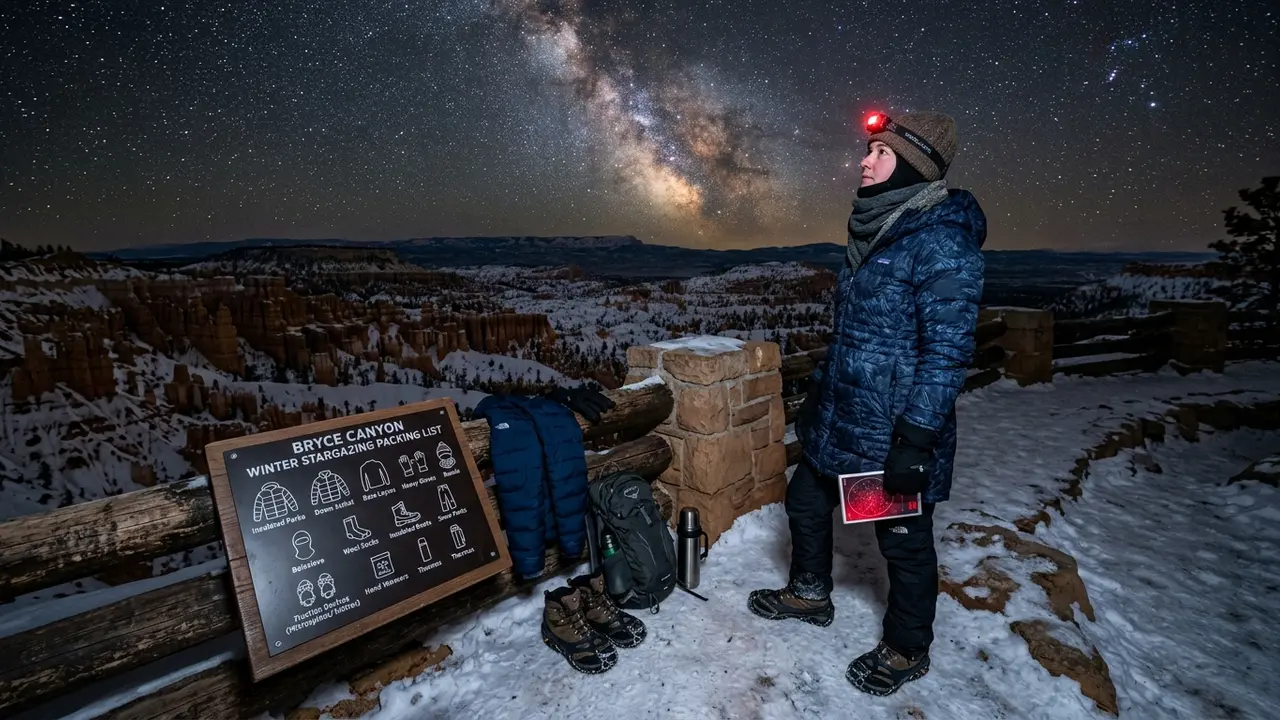
A three-layer system covers it. A moisture-wicking base layer, merino wool or a synthetic equivalent, never cotton, since a wet cotton layer stops insulating and starts pulling heat straight off your skin. A fleece or wool mid layer for actual warmth, topped with an insulated down or synthetic jacket. Then a windproof outer shell with a real hood, since wind funneling along the rim cuts through an unlined jacket fast even on an otherwise calm night.
Featured · Destination
Stargazing in Bryce Canyon National Park
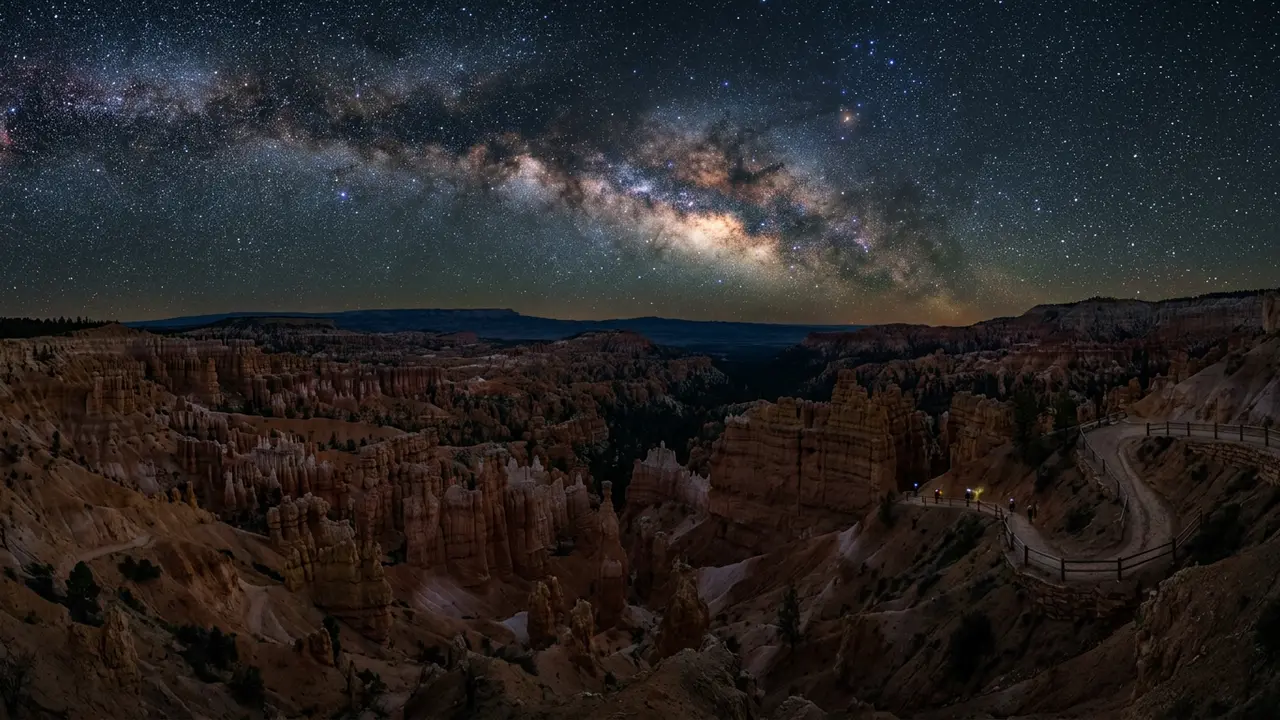
Bryce Canyon earned Gold-Tier Dark Sky Park status in 2019 after 50 years of astronomy programs. Drive in from Vegas or Salt Lake City to see it for yourself.
Insulated snow pants or bib overalls matter more here than in a milder winter destination, since you'll likely be standing on packed snow or frozen ground rather than a cleared patio. A small foam pad or folding stool earns its space in the bag if you plan to sit through a long exposure sequence: frozen rock and packed snow pull heat out of you through direct contact faster than the air temperature alone suggests.
Footwear and Traction: The Real Winter Hazard Underfoot
Cold air is only half the problem. The bigger practical hazard at Bryce in winter sits underfoot, not overhead: packed snow and ice on the paved overlooks and the popular rim trails, exactly where you'll be standing for a stargazing session. The National Park Service recommends traction devices for footwear, lightweight slip-on crampons or similar, specifically because of icy, packed trails and paved areas[3].
Pack a pair that slips over your regular winter boots rather than relying on tread alone. A boot with aggressive tread still slides on glazed ice; a lightweight traction device doesn't, and it packs down to almost nothing in a daypack. Insulated, waterproof boots underneath round out the kit. This isn't a place that demands arctic-rated boots built for -40°F, but it does demand boots built to keep your feet warm while standing on cold, wet ground for an hour or more.
Snow depth also varies more across the park than a single number suggests. Snow accumulation varies across the park depending on elevation, so a spot that looks lightly dusted near the entrance can be genuinely snowed-in a few miles further out. Check current conditions for the specific overlook you're planning to visit, not just the park as a whole, before you decide how much traction gear to bring.
What Closes in Winter: Roads and Trails to Plan Around
Winter access to Bryce Canyon isn't guaranteed just because the park stays open year-round. The park's main road can close entirely beyond mile marker 3 after a heavy snowstorm, until plowing crews clear it[4]. The stretch before that marker, covering the Bryce Amphitheater area and its main overlooks, gets plowed first and stays accessible through most temporary closures. If your stargazing plan depends on a viewpoint further out on the road, build a backup night into the itinerary.
Some spur roads close for the entire winter season rather than temporarily. Neither reopens until spring, so cross both off the list for a winter trip rather than hoping for a clear day to change that.
| Closure | Where | What it means for your trip |
|---|---|---|
| Main Road (temporary) | Beyond mile marker 3 | Plowed last during storms; overlooks past mile 3 may be inaccessible for a day or more |
| Fairyland Point spur road | 1-mile spur road | Closed for the entire winter season |
| Paria View spur road | 0.3-mile spur road | Closed for the entire winter season |
| Rim Trail (Inspiration Point to Bryce Point) | Cliff-edge trail segment | Closed all winter due to snow-cornice hazard |
| Wall Street (Navajo Loop) | Trail segment | Closed for rockfall risk; loop becomes an out-and-back |
Trails close too, for reasons worth taking seriously rather than treating as bureaucratic caution. The stretch of the Rim Trail between Inspiration Point and Bryce Point shuts down for the entire winter because snow builds into overhanging snow cornices along the cliff edge, a genuine fall hazard rather than a formality[5]. The Wall Street section of the Navajo Loop closes for a different reason, rockfall risk rather than snow, which turns the popular Queen's Garden loop into an out-and-back hike instead of a loop for the whole season[6].
None of this is a reason to skip a winter trip. It's a reason to check current road and trail status the morning you drive out, rather than assuming the map from last summer's visit still applies.
The Bryce Canyon Winter Stargazing Packing List
Pull this list together before you leave home, not after you land. Tropic, the closest town to the park entrance, has limited shopping, and the nearest real outdoor gear stores are in Cedar City or St. George, each over an hour's drive away.
If you're staying at the in-park lodge, the short walk from your room to the amphitheater rim is one of the better arguments for booking inside the park boundary in winter: no cold car interior to warm up before you can head back out for a second look at the sky. Wherever you're based, here's what actually earns space in the bag.
Recommended tours
Tours are selected for quality, not commission. I earn a small fee if you book — at no extra cost to you.
Clothing and footwear:
- Moisture-wicking base layer, top and bottom (merino wool or synthetic, never cotton)
- Fleece or wool mid layer, plus an insulated down or synthetic jacket
- Windproof, water-resistant outer shell with a full hood
- Insulated snow pants or bib overalls
- Insulated, waterproof winter boots
- Slip-on traction devices that fit over your boots
- Wool or synthetic hiking socks, one thick pair per day plus spares
- Warm hat covering the ears, plus a neck gaiter or scarf
- Insulated gloves, plus a thin liner pair if you'll be handling a camera
Gear and extras:
- Headlamp with a red-light mode, to protect your night vision and everyone else's
- A sturdy tripod for a camera or binoculars
- A small foam pad or folding stool for a long stationary session
- A thermos for something hot between viewing stints
- Chemical hand and toe warmer packets
- A portable phone charger; cold drains batteries fast at elevation too
- A downloaded or printed note of current road and trail closures, since cell service is unreliable in the park
None of this needs to be arctic-expedition grade. It needs to survive an hour or two of standing still on cold rock at 8,000 feet[1], with enough traction underfoot to get back to the car without a fall.
When to Go and How Many Nights to Plan For
December through February is Bryce's coldest stretch, though exactly which month gets the most snow varies year to year, so build slack into a winter trip rather than pinning everything to one date. A closed spur road or a temporarily plowed-out main road on your one scheduled night can cost you the whole trip if there's no second night to fall back on.
Best time to stargaze at Bryce Canyon covers the full seasonal trade-off, winter's clearer, colder air against summer and fall's easier access, in more depth than fits here. If you're still working out how to actually reach the park, Getting to Bryce Canyon covers the drive in and the seasonal shuttle. And if this is your first cold-weather stargazing trip anywhere, Stargazing gear for beginners covers what's worth owning before you build out a destination-specific list like this one.
Featured · Article
What Is Astrotourism? The Complete Beginner's Guide
Astrotourism means travel built around dark skies: meteor showers, auroras, the Milky Way. What it means, where to go, and how to plan your first trip.
Bryce's winter reward is real: darker, more transparent air than the park sees the rest of the year, hoodoos dusted white under a clear night sky, and viewpoints you'll likely have mostly to yourself. Check the road and trail status the morning you drive out, pack for real cold rather than deep-Arctic cold, and the rest of the trip takes care of itself.