
The Short Answer: What You're Actually Weighing

Death Valley is worth the trip for a stargazer who can plan around summer heat the way a mountaineer plans around altitude: as a real constraint to build a schedule around, not an afterthought. It's a harder sell for anyone hoping to combine it with a casual weekend getaway, or for a family banking a whole vacation on one clear night after driving out from Las Vegas.
That split matters because the payoff really is that good. Death Valley holds Gold Tier Dark Sky Park certification from the International Dark-Sky Association[1], the highest rating the organization gives, and its skies measure Bortle Class 1-2[2], as dark as naked-eye stargazing gets anywhere in the continental United States. The park's desert climate also keeps its skies reliably clear through most of the year, so a trip here isn't the weather gamble a coastal or mountain dark-sky destination often is.

None of that is in question. What's worth weighing honestly before booking flights to Vegas and a rental car:

  • Extreme summer heat that the National Park Service itself warns visitors not to underestimate
  • A genuinely remote location, roughly two hours from the nearest city with real services
  • A park so large that "Death Valley" isn't one stargazing spot, it's dozens of them spread across a few million acres of desert
This is the same trade-off stargazing in Death Valley National Park walks through from the destination side, worth reading before you commit the days off, not after.

The Heat: What Summer Actually Feels Like

Heat here isn't a minor inconvenience to plan around. It's the single biggest variable in whether a summer trip is enjoyable or genuinely miserable. The summer of 2024 set a record with an average high of 117.3°F[3], and nightly lows hold in the 85 to 95°F range even at that peak, meaning the only real relief in a 24-hour cycle comes in the hour or two before dawn.
The danger is real, not just uncomfortable. Heat-related deaths happen in Death Valley nearly every summer[4], and park rangers don't soften that fact in their seasonal advisories. That's not a reason to cancel a July stargazing trip, but it is a reason to treat hydration, air conditioning, and vehicle reliability as seriously as the astrophotography gear list.

117.3°F

The record average high Death Valley posted in summer 2024. Nightly lows still hold in the 85-95°F range even at that peak, so the only cool stretch of the day is the hour or two before sunrise.
For visitors set on a summer date anyway, the practical adjustments are straightforward: schedule stargazing for the hours right after sunset or before dawn, carry more water than feels necessary, and treat air conditioning as infrastructure rather than a luxury. None of that erases the risk, but it's the same math dedicated desert travelers already run across Utah, Arizona, and the wider Mojave.
The part worth remembering is that this isn't a year-round problem. Fall through spring, Death Valley's overnight temperatures drop into genuinely comfortable stargazing range, and the same Gold Tier skies apply without any of the summer risk. Anyone with flexible dates has an easy way around the whole issue.

Remoteness: The Drive, the Elevation, and the Emptiness
Death Valley isn't a quick detour off the Strip. The drive from Las Vegas runs through Pahrump on Highway 190 and takes roughly two hours each way[5], longer with a gas or grocery stop, both of which get scarce once you're inside the park boundary. That distance is part of what keeps the skies dark, but it also means a full tank, a charged phone with offline maps, and a plan for the return drive at 1 a.m. after a night of shooting stars.
The park's elevation range is almost as extreme as its heat. Death Valley spans from 282 feet below sea level at Badwater Basin to over 11,000 feet at its highest points[6], and a favorite stargazing overlook, Dante's View, sits at 5,476 feet[7]. That range does real work for stargazers: gaining elevation lifts you above some of the valley floor's heat and haze, and the park's extreme aridity produces exceptional atmospheric transparency, the kind of crisp, unobstructed horizon-to-horizon view that flatter, more humid parks rarely offer.

Featured · Destination

Abisko Stargazing

Abisko's rain-shadow microclimate keeps skies clear when nearby Arctic spots cloud over. Aurora season, the Sky Station, ICEHOTEL, and getting there by train.

None of this is a reason to skip Death Valley. It's a reason to treat the drive and the terrain as part of the trip's planning, not a detail squeezed into a day trip from a Vegas hotel room.

Logistics: Lodging, Hiking Rules, and Where to Point Your Telescope

Summer lodging in Death Valley narrows to almost one option. The Ranch at Death Valley (formerly Furnace Creek Ranch) is the park's only air-conditioned, spring-fed-pool property that stays open through the worst of the heat, and during peak summer it becomes the de facto only real lodging choice inside the park[8]. The Inn at Death Valley is the property most stargazers actually book, and it's worth comparing what a night there costs against driving in fresh from Pahrump each evening.

The National Park Service is direct about what not to do: it explicitly does not recommend hiking the park's lower elevations in summer[9]. Where to point that observing time matters more than where you sleep, since the actual stargazing happens standing still at an overlook or a dune field, not on a trail. Four spots come up again and again among people who've actually done this:

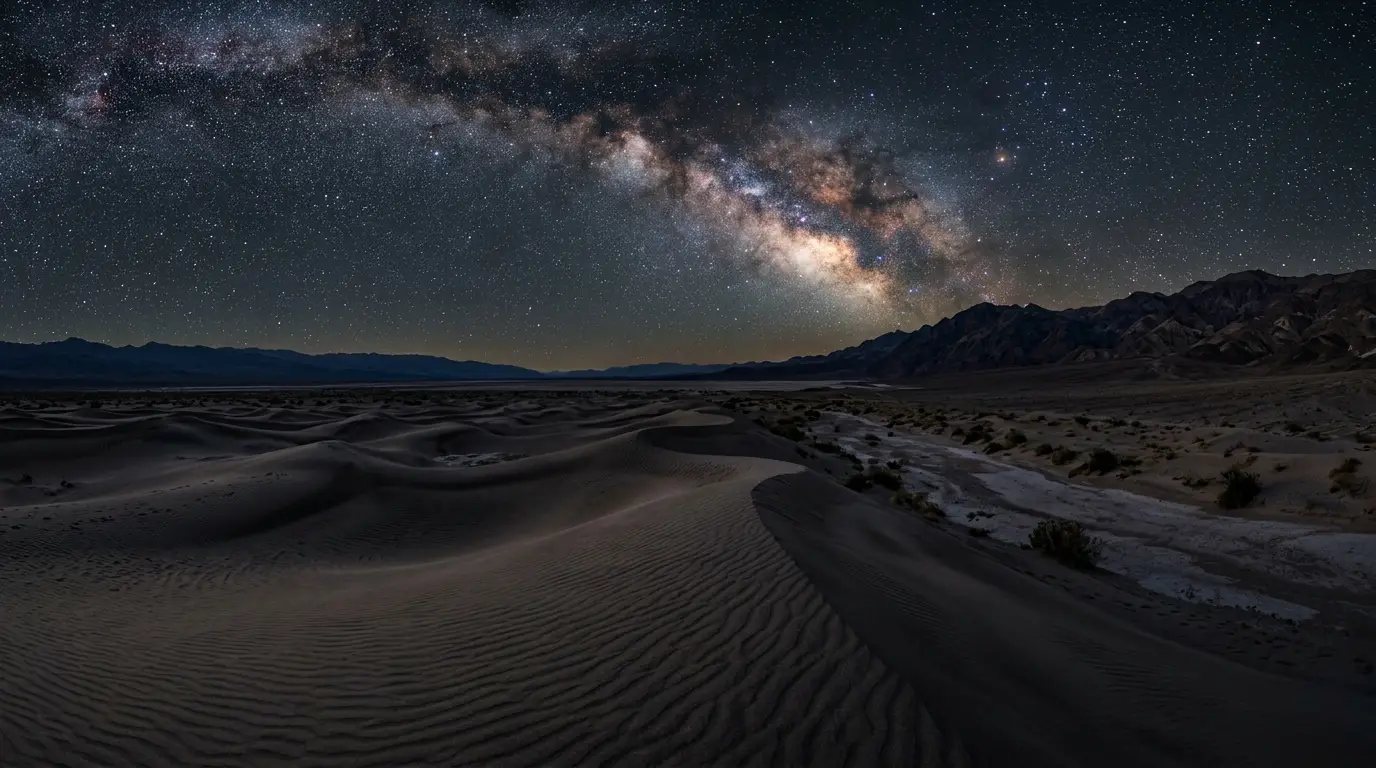
  • Mesquite Flat Sand Dunes: the classic Milky Way foreground, rippled sand under open sky
  • Dante's View: an elevated panorama that looks down over 5,000 feet to the valley floor, with sweeping views across the park[10]
  • Harmony Borax Works: close to the main road and easy to reach after a short evening drive[11]
  • Racetrack Playa: the most remote of the four, favored by stargazers chasing the darkest conditions the park offers
Each rewards a different kind of visit. The dunes suit photographers who want a foreground in frame, the Racetrack suits anyone willing to drive hours of washboard road for the darkest sky the park has to offer.
Where to point that observing time matters more than where you sleep.
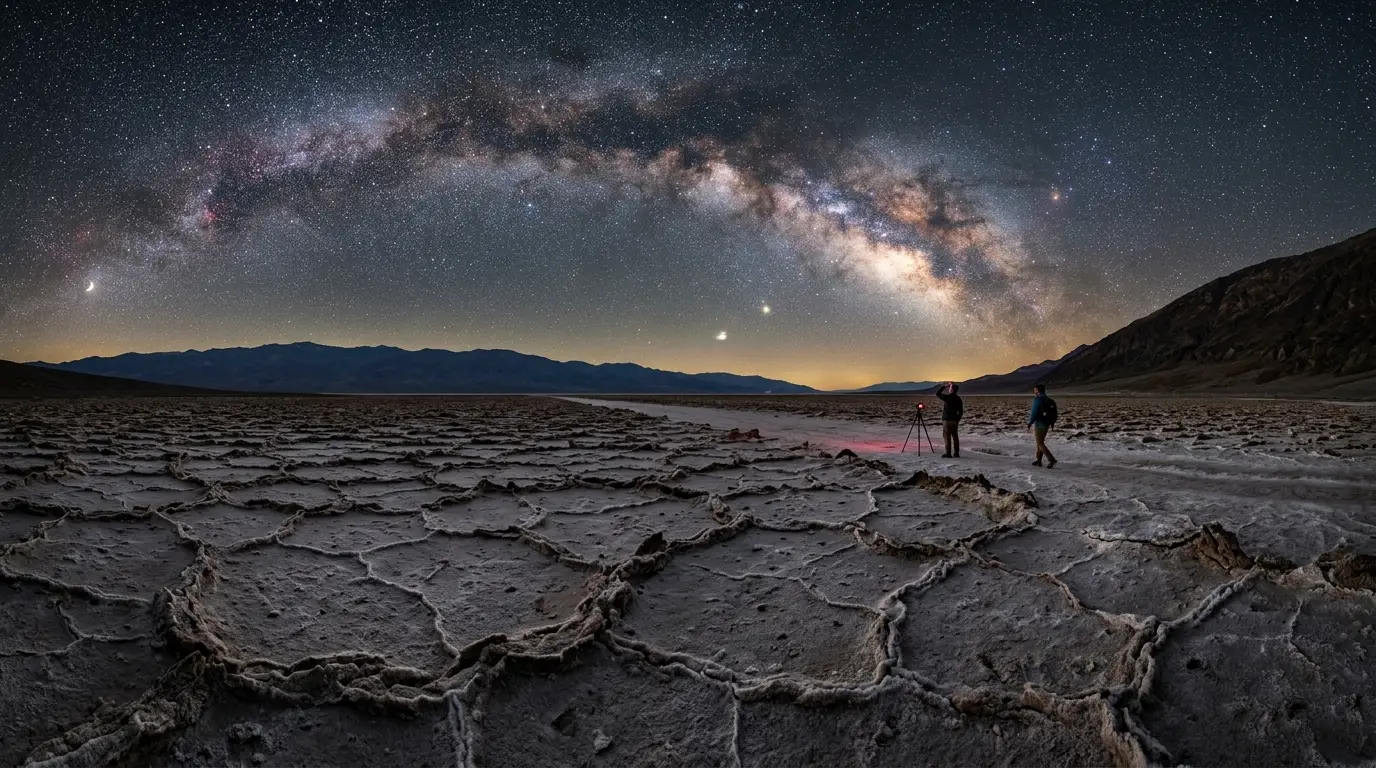
Is Death Valley worth it for stargazing? Night view of the Racetrack Playa's cracked earth beneath a dense band of the Milky Way, no artificial light for miles.

Is Death Valley worth it for stargazing? Night view of the Racetrack Playa's cracked earth beneath a dense band of the Milky Way, no artificial light for miles.

So, Is It Worth It? Who Should Go and Who Should Wait

Death Valley is worth it for a stargazer who builds in at least two nights, since a single overnight leaves no buffer if wind, haze, or a bad moon phase ruins the one session the whole trip was planned around[12]. It's worth it for astrophotographers chasing a genuinely dark foreground, and for anyone who wants a guided stargazing experience without navigating unfamiliar desert roads after dark themselves: several outfitters run tours from Las Vegas that combine telescope viewing with constellation guidance, departing in the early morning to reach the park by nightfall[13].
Preparation matters more here than at most dark-sky destinations. The National Park Service recommends drinking at least one gallon of water a day[14] in Death Valley's dry heat, more than most national park visits require, and that number doesn't change just because you're standing still at an overlook instead of hiking a trail.

It's a harder case for:

  • Anyone treating this as a casual weekend add-on to a Vegas trip, with no flexibility if the first night clouds over
  • A traveling companion who is heat-sensitive or manages a health condition the National Park Service flags as a summer risk
  • Anyone hoping for a spontaneous, unplanned visit rather than one built around water, fuel, and a lodging reservation
Featured · Article

What Is Light Pollution? Definition, Types, and Solutions

Light pollution is artificial light brightening the night sky, affecting 80% of the world. Learn the 4 types, wildlife and health effects, and how to fix it.

None of those are reasons to write the park off. They're reasons to plan for what Death Valley actually asks of a visitor, rather than discovering it on arrival. For the timing that makes the difference between a wasted night and a clear one, the best time to stargaze in Death Valley covers the specific months and moon-phase windows worth building a trip around.

How Death Valley Compares to Other Dark-Sky Trips

Set against closer alternatives, Death Valley's appeal comes into focus. Joshua Tree sits roughly two and a half hours from Los Angeles, and Owens Valley sites run closer to one or two, both reachable without the same heat exposure or drive time from a major hub. For a casual stargazer who wants a dark sky without committing a full weekend to logistics, either is an easier first trip than Death Valley.
Weighed against fly-in destinations like Mauna Kea or the Atacama Desert, Death Valley looks different again: no flights, no altitude acclimatization measured in days, no charter operator standing between you and the sky. What it asks for instead is heat tolerance and a rental car. Neither trade-off is objectively better; it depends on whether you'd rather manage heat or manage a flight itinerary, and how much a truly dark sky is worth to you either way.
FactorDeath ValleyCloser alternative (Joshua Tree / Owens Valley)
Distance from major hub~2 hours from Las Vegas1-2.5 hours from Los Angeles
Summer heat riskExtreme; NPS heat warnings, strict water discipline requiredMilder; still hot but rarely record-breaking
Sky darknessGold Tier, Bortle 1-2Typically Bortle 2-3, dark but slightly less extreme
Best forDedicated astrotourists, astrophotographersCasual stargazers, a first dark-sky trip
The comparison that actually sticks isn't logistical. It's what the sky looks like once you're standing under it. From a typical Southern California campus, roughly a dozen stars are visible on a clear night; at Death Valley, the sky reaches all the way to the horizon in every direction, the way it did for anyone standing in the same spot a century ago[15]. That's the payoff the heat and the two-hour drive are buying.