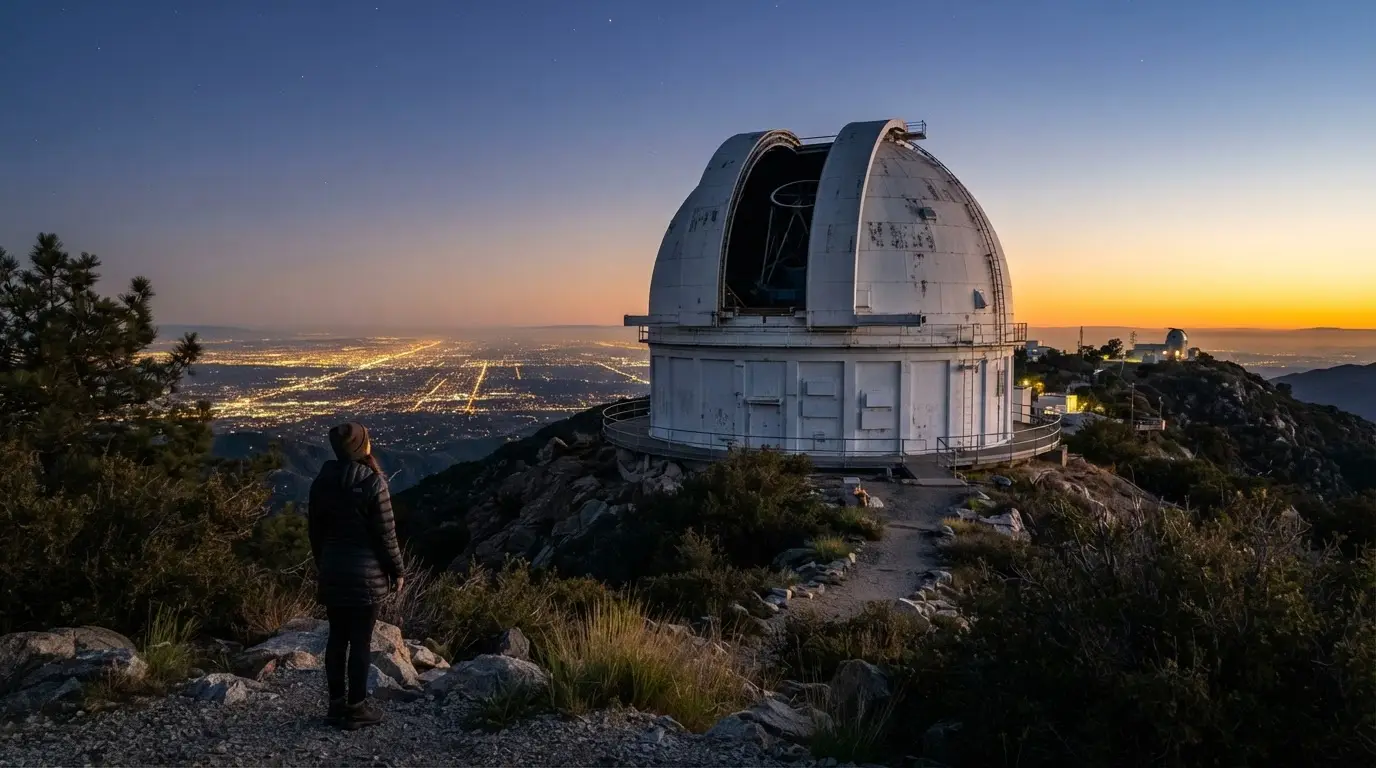
Mount Wilson Observatory light pollution history: the white Hooker telescope dome on the summit at dusk, the glow of the Los Angeles basin on the horizon below

Mount Wilson's Telescope Proved Expansion, Then LA Outshone It
Hubble showed the universe expands from Mount Wilson, then Los Angeles glare pushed Carnegie's deep-sky work to Chile. The dated story, and what to visit.

Portrait of Maya Okonkwo
Written by

I've seen dark skies firsthand in the Atacama altiplano, Namibia's NamibRand Nature Reserve, and Morocco's Merzouga dunes; every other destination I write about is built from measured Bortle and SQM data, cloud climatology, and primary sources like park services and the International Dark-Sky Association.

Published
Edwin Hubble showed that the universe is expanding with the 100-inch Hooker telescope on Mount Wilson[1], and about six decades later the glow of Los Angeles was the reason Carnegie gave for handing the historic telescopes to the Mount Wilson Institute, a transfer it dates to 1986[2]. Other accounts put the break at 1984 or 1989[3][4], so any single year is one source's date. The mountain still earns a visit for its history and its steady air, but not for the dark sky Hubble's name might promise.
Summit altitude
5,715 ft
Above Pasadena in the San Gabriel Mountains[22]
Handover to the Institute
1986
Carnegie's date for the transfer of the historic telescopes[2]
Hooker's gift for the mirror
$45,000
A Los Angeles industrialist's 1906 grant for the 100-inch glass[7]

The 100-inch and one plate in October 1923

Hubble used the 100-inch Hooker to settle an argument about scale. Spiral nebulae like Andromeda might have been clouds inside our own galaxy; he showed that a universe lies beyond it[5]. The telescope was the largest in the world until Palomar's 200-inch arrived in the late 1940s[6], and its glass was bought with a $45,000 grant that Los Angeles industrialist John Hooker gave Carnegie in 1906[7]. Los Angeles money bought the mirror; Los Angeles light would later cost it its sky.
The proof was a single star on a plate exposed on the night of 5-6 October 1923[8]. Hubble first took it for a nova, then found that it brightened and faded like a Cepheid, a variable whose pulsation period tracks its true brightness[9]. Compare that true brightness with how faint the star looks and you have a distance. Date the work by the exposure and it is 1923; date it by the finding and it is 1924[10].

Expansion in 1929, and a field already looking elsewhere

Six years later came the result that made the name. Hubble's 1929 paper showed galaxies receding from us in every direction, the farther ones receding faster in proportion to distance[11], and Humason's work with him gave the linear relationship that became evidence for an expanding universe[12].
Mount Wilson's astronomers were already planning the successor. In 1928 they helped talk the Rockefeller Foundation into funding a 200-inch telescope on Palomar Mountain[13]. Once it was working, the leading edge of cosmology moved with it, to remote summits such as Mauna Kea in Hawaii and to Chile and Australia[14].

The 1980s: Carnegie follows the dark sky to Chile

Los Angeles kept growing after World War II, and the skies above Mount Wilson brightened with it[15]. They had started out comparatively dark: Crumey's analysis of Bowen's 1947 limiting-magnitude data puts the zenith sky at about 21.61 mag/arcsec²[16], darker than the 20.82 that Garstang's model gave for 1950[17]. That gap implies that light pollution grew more rapidly in the decades after 1947 than earlier models supposed[18].
Deep-sky work lives on faint galaxies, and no mirror, however large, can pull a faint galaxy out of a bright sky, which is the basic harm of light pollution. Mount Wilson probably hit bottom in 1984, when its owner and main patron, Carnegie, chose to send its money to Chile[3].
Chile was no improvisation. Carnegie had set up Las Campanas Observatory in 1969 in the southern Atacama Desert, the same high-desert region as today's Atacama observatories[19].
What stayed behind was an arrangement: Carnegie remains the owner and the Mount Wilson Institute the operator[20].

What the mountain still does well

Mount Wilson's summit sits at 5,715 feet above Pasadena in the San Gabriel Mountains[22], and the inversion layer over the basin calms the air there enough that it ranks among the steadiest viewing sites on the continent[23]. Steady air is not a dark sky. Astronomers call the first seeing, while the Bortle scale rates how much glow washes out the stars, and Mount Wilson is superb at one and poor at the other.
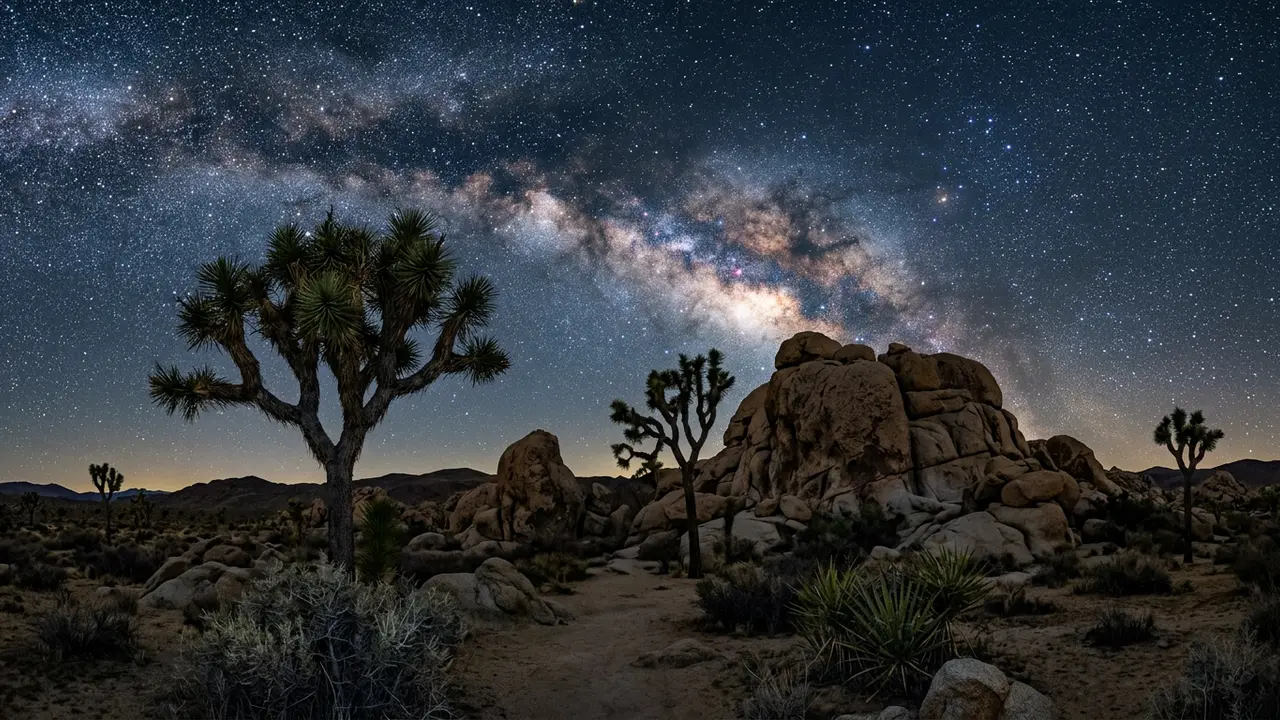
Star-filled night sky over Joshua Tree's boulder formations and namesake trees, an International Dark Sky Park two hours from Los Angeles

Featured · Destination

Joshua Tree National Park

Joshua Tree earned International Dark Sky Park status in 2017, just two hours from LA. Here's where to see the Milky Way, dodge crowds, and stay the night.

That split explains the 100-inch's second life. It closed in 1984 and reopened in 1994, per the Institute's account, wearing computer-controlled pointing and adaptive optics[24].
Research did not stop either. The city's lights have cut the mountain's usefulness for some observations, yet work there is still described as vital and ongoing[25], and regular scheduled public observing through the 100-inch began with the 2015 season[26].

Recommended tours

Tours are selected for quality, not commission. I earn a small fee if you book — at no extra cost to you.
My read is that Mount Wilson works best as a history trip with excellent optics, paired with a night somewhere properly dark. The same Los Angeles glow that ended its deep-sky career caps what any visitor can expect from the sky above the summit, so go for the telescope and the story, and keep your Milky Way ambitions for another trip.

Visiting the mountain Hubble used

The place itself is the case for going. Hubble sat in the 100-inch dome on many nights through the 1920s and 1930s[27], and in October 2019 the American Physical Society presented a plaque marking the site for the discoveries of Hubble, Humason and Baade[28].
Practicalities shift by season. The grounds have been listed as free to enter, daily from 10 am to 5 pm[29]. That is a listing, not a schedule.

Confirm before you drive up

Tour times, ticket-night prices and seasonal closures change, and fire closures have shut the site before. Check the Mount Wilson Institute's official site first, and treat the figures here as background, not a schedule.
The telescopes are the draw. Observing nights on the 60-inch and 100-inch are limited to 16 to 20 people and sell out quickly[30], so book early and check the Mount Wilson Institute's own site first.
Fire is the other thing the mountain lives with, and it has twice come close enough to change a visit:
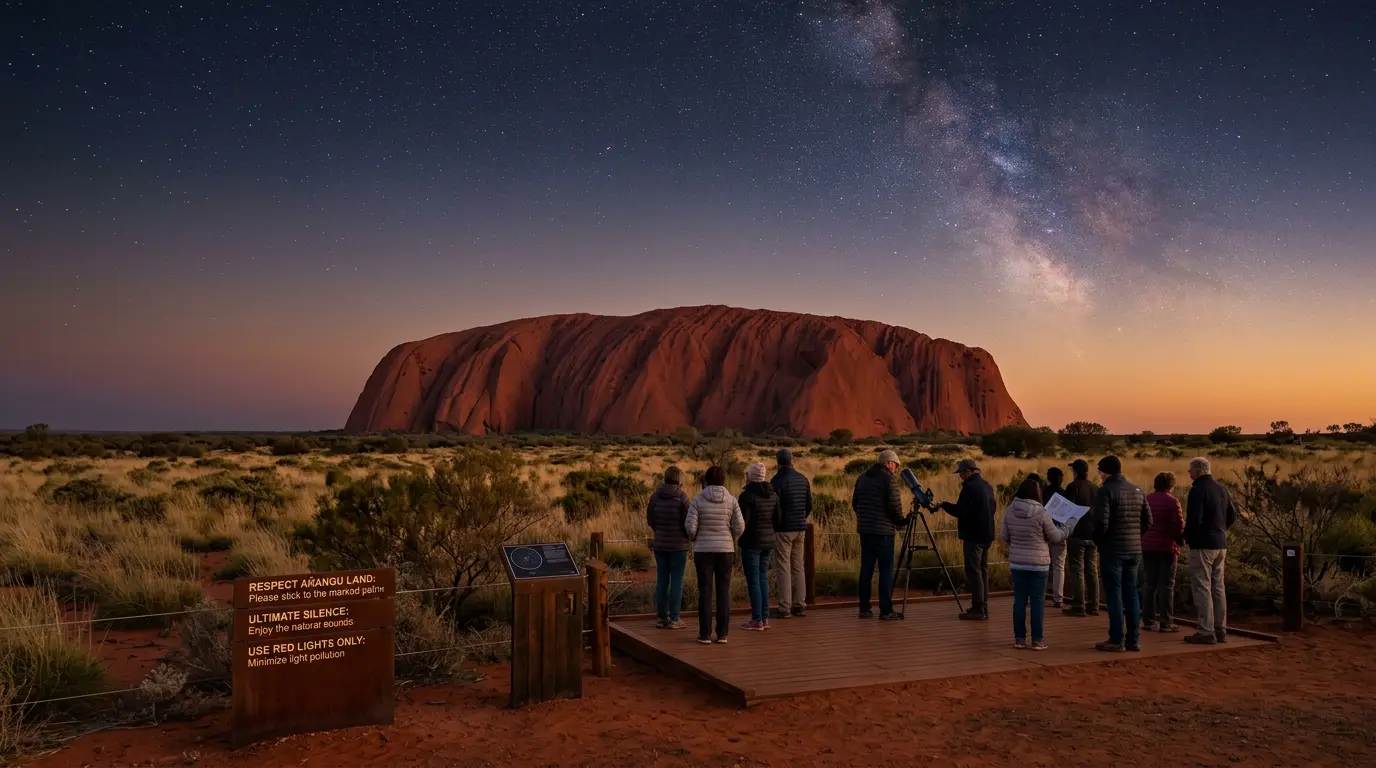
Wide, respectful photograph of Uluru glowing red at dusk under a star-filled sky on Anangu land, capturing Uluru's cultural significance and the visitor etiquette every stargazer should know

Featured · Article

Uluru Cultural Significance and Visitor Etiquette

Uluru is Anangu land under joint management. Here's why the 2019 climb closure is settled policy, what you can't photograph, and real visitor etiquette.

  • During the Bobcat Fire the flames came within 150 metres (500 feet) of the observatory by 15 September[31].
  • After the Eaton Fire nearly burned the site down, it reopened to the public more than four months later[32].
If darkness is the point of your trip, drive to Joshua Tree or Death Valley instead. Mount Wilson is the one you visit for what the glow cost astronomy.

Frequently asked questions

What is the Mount Wilson Observatory light pollution history?

Los Angeles kept growing after World War II and its glow brightened the sky over the mountain[15]. By 1984 Carnegie was shifting its financial support to Chile[3], and Carnegie dates the handover of the historic telescopes to the Mount Wilson Institute to 1986[2].

Can you still look through the Hooker telescope at Mount Wilson?

Public observing nights on the 100-inch are limited to 16 to 20 people and sell out quickly[30], and regular scheduled observing began with the 2015 season[26]. Confirm dates and prices with the Mount Wilson Institute, which operates the observatory for its owner, Carnegie[20].

Did Hubble make his expanding-universe discovery at Mount Wilson?

Hubble used the 100-inch telescope to show that a universe exists beyond the Milky Way[5], and Carnegie credits him with showing in 1929 that the universe is expanding[1].

Sources

32 references Show
  1. carnegiescience.edu — Universe edwin hubble (opens in a new tab)

    “most significantly in 1929 when he showed that the universe is expanding”

  2. carnegiescience.edu — Observatories history (opens in a new tab)

    “In 1986, as light pollution encroached from the Los Angeles basin, day-to-day operation of the historical telescopes on Mount Wilson was transferred to the Mount Wilson Institute”

  3. csmonitor.com (opens in a new tab)

    “Mt. Wilson probably reached its nadir in 1984 when the Carnegie Institution, its owner and prime patron since early this century, decided to shift financial support to telescopes in Chile”

  4. Wikipedia (opens in a new tab)

    “In 1989, the Carnegie Institution, which ran the observatory, handed it over to the non-profit Mount Wilson Institute.”

  5. carnegiescience.edu — Universe edwin hubble (opens in a new tab)

    “Using the 100-inch telescope, legendary astronomer Edwin Hubble demonstrated the existence of the universe beyond our own Milky Way galaxy”

  6. carnegiescience.edu — Observatories history (opens in a new tab)

    “The Hooker telescope was the largest in the world from 1917-1949”

  7. aps.org (opens in a new tab)

    “In 1906, John Hooker, a Los Angeles industrialist and amateur scientist, gave Carnegie a grant of $45,000 to purchase a 100-inch glass mirror for a large reflecting telescope.”

  8. carnegiescience.edu — M31var (opens in a new tab)

    “On the night of October 5-6, 1923, Carnegie astronomer Edwin P. Hubble took a plate of the Andromeda Galaxy (Messier 31) with the Hooker 100-inch telescope of the Mount Wilson Observatory.”

  9. carnegiescience.edu — M31var (opens in a new tab)

    “showing that Hubble originally thought it was a nova, but eventually discovered that it varied in brightness like a Cepheid.”

  10. pmc.ncbi.nlm.nih.gov (opens in a new tab)

    “This finding was in 1924”

  11. pmc.ncbi.nlm.nih.gov (opens in a new tab)

    “Hubble showed that galaxies recede from us in all directions and more distant ones recede more rapidly in proportion to their distance.”

  12. aps.org (opens in a new tab)

    “He and his assistant Humason discovered a linear relationship between the distances of galaxies and how fast they are moving away from Earth, evidence for an expanding universe.”

  13. carnegiescience.edu — Observatories history (opens in a new tab)

    “Striving to push deeper into the universe, in 1928 the Carnegie and Mount Wilson astronomers persuaded the Rockefeller Foundation to fund a 200-inch telescope on Palomar Mountain.”

  14. astronomy.com (opens in a new tab)

    “With the arrival of the 200-inch, cosmology research shifted to Palomar and, later, to newer big telescopes at remote sites in Chile, Hawaii, and Australia.”

  15. astronomy.com (opens in a new tab)

    “As Los Angeles grew after World War II, the skies brightened”

  16. arxiv.org (opens in a new tab)

    “B = 2 .45 × 10 −4 cd m -2 (μsky = 21 .61 mag arcsec -2 )”

  17. arxiv.org (opens in a new tab)

    “Garstang estimated this parameter, guided partly by his analysis of Bowen’s data, producing results somewhat darker than his previous work (20.82 mag arcsec -2 for 1950), but still considerably brighter than the new estimate.”

  18. arxiv.org (opens in a new tab)

    “The result is darker than the calculation by Garstang (2004), implying that light pollution grew more rapidly in subsequent decades than has been supposed.”

  19. carnegiescience.edu — Observatories history (opens in a new tab)

    “The Las Campanas Observatory–located at a superb site high in the southern reaches of Chile's Atacama Desert–was established in 1969.”

  20. aps.org (opens in a new tab)

    “The observatory continues to be owned by the Carnegie Institution and is operated by the Mount Wilson Institute.”

  21. naturalresources.house.gov (opens in a new tab)

    “By the end of that decade, the Institution decided to put its resources for astronomy at Las Campanas and to close Mount Wilson.”

  22. visitpasadena.com (opens in a new tab)

    “A historic site located on Mount Wilson in the San Gabriel Mountains above Pasadena at an altitude of 5,715 feet.”

  23. csmonitor.com (opens in a new tab)

    “The inversion layer suppresses turbulence over the mountaintop, making 5,800-foot Mt. Wilson probably the best viewing peak in North America.”

  24. astronomy.com (opens in a new tab)

    “The 100-inch telescope closed in 1984, but in 1994 the Mount Wilson Institute re-opened it with new computer-controlled pointing and tracking and adaptive optics.”

  25. discovermagazine.com (opens in a new tab)

    “have reduced its usefulness for some observations, research at Mount Wilson is still a vital, ongoing concern.”

  26. Wikipedia (opens in a new tab)

    “Regularly scheduled observing began with the 2015 observing season.”

  27. csmonitor.com (opens in a new tab)

    “It is the place where Edwin Hubble, dressed in heavy tweeds of the day, sat many nights in the 1920s and 1930s as he made 20th-century astronomy's greatest discovery: the existence of an expanding universe.”

  28. aps.org (opens in a new tab)

    “At a ceremony in October, 2019 APS President David Gross presented a plaque marking the site as the place where astronomers Edwin Hubble, Milton Humason, and Walter Baade made world-changing discoveries about the cosmos.”

  29. visitpasadena.com (opens in a new tab)

    “Free of charge and open to the public daily from 10 am - 5pm”

  30. timeout.com (opens in a new tab)

    “(limited to just 16 to 20 people) and exceptionally popular, so expect them to sell out quickly.”

  31. universetoday.com (opens in a new tab)

    “By Sept. 15th, the fire reached within 150 m (500 ft) of the observatory and firefighters and helicopters were deployed to the area to protect it.”

  32. abc7.com (opens in a new tab)

    “The Mount Wilson Observatory is reopening to the public more than four months after the devastating Eaton Fire nearly burned down the Southern California landmark.”