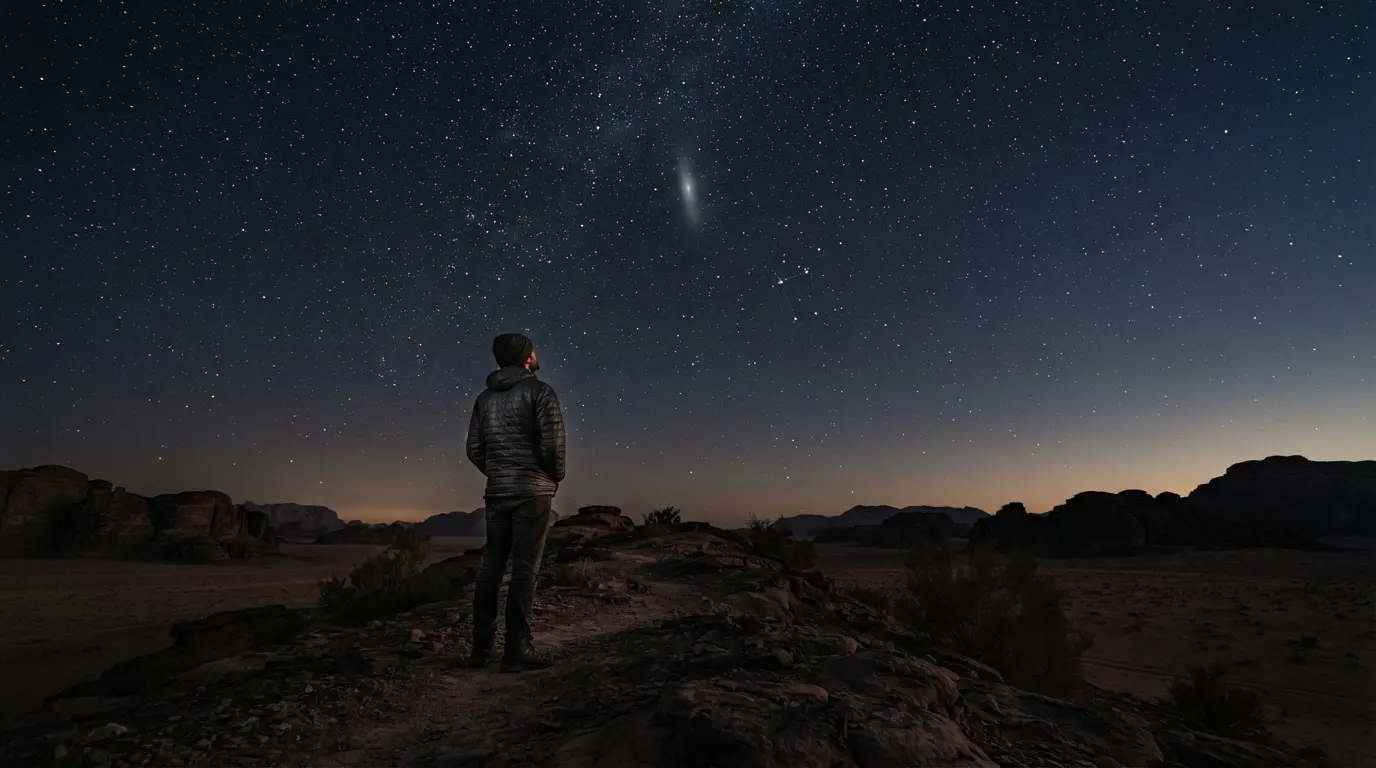
The farthest thing you can see naked eye: the Andromeda Galaxy as a pale elongated smudge above a dark desert horizon, with Cassiopeia and the Great Square of Pegasus in a rich night star field

What Is the Farthest Thing You Can See With the Naked Eye?

Andromeda, 2.5 million light-years away, is the farthest permanent object most people see unaided. Here is the dark sky it needs, and why Triangulum is harder.

Portrait of Maya Okonkwo
Written by

I've seen dark skies firsthand in the Atacama altiplano, Namibia's NamibRand Nature Reserve, and Morocco's Merzouga dunes; every other destination I write about is built from measured Bortle and SQM data, cloud climatology, and primary sources like park services and the International Dark-Sky Association.

Published
Andromeda, about 2.5 million light-years away, is the farthest permanent object most people can reliably see with their own eyes[1], and a poor sky will take it from you. Triangulum is slightly farther, but only for some dark-adapted observers[2], and in practice it needs perfect dark sky and good eyesight[3]. Whether you catch either depends on how close your sky gets to the 6.0 to 6.5 naked-eye limiting magnitude usually cited[4], and in the worst city skies Andromeda vanishes entirely.
Andromeda's distance
2.5 Mly
Most distant thing comfortably visible to the unaided eye[1]
Common limiting magnitude
6.0 to 6.5
Naked-eye limit more commonly cited than Bortle's own figures[4]
Age of sunlight
8.3 minutes
The Sun is always seen as it was 8.3 minutes ago[5]

Why Andromeda holds the record

Andromeda is the farthest permanent object most observers can see reliably, and each of those qualifiers carries weight. It is not a showy object, and it does not need to be: under most viewing conditions it is one of the most distant things the naked eye can pick out because of how much sky it covers[6]. In a dark sky the glow reads as a smudge larger than a full Moon[7], although NASA's plainer description of the naked-eye view is a faint, spindle-shaped object roughly the Moon's angular size[8].
The rest of the story is where those qualifiers stop holding: a runner-up that needs a better sky and sharper eyes, and a one-off flash that was visible for half a minute.

Reading 2.5 million light-years as an age
A light-year is a distance, but it works just as well as a clock. Light travels at a finite speed, so the glow reaching you from Andromeda is the galaxy as it was 2.5 million years ago[9], in the same way the Sun you see is the Sun from 8.3 minutes earlier[5]. The Sun is the everyday case, and Andromeda is the same effect stretched as far as an unaided eye can take it.
None of that means the galaxy has changed beyond recognition while its light travelled. Andromeda is approaching at roughly 110 km/s, and if it has held that speed and direction it has covered only about 900 light-years in the 2.5 million years its light has been under way[10]. Against the full distance that is a rounding error, so the sky is showing you something close to the galaxy's present position.
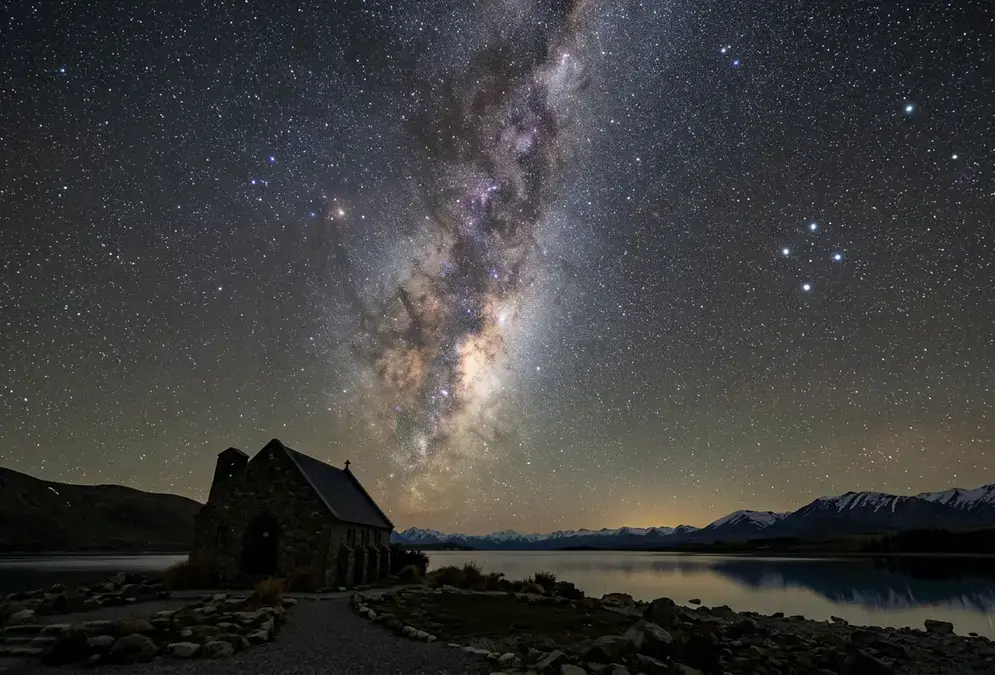
Milky Way arching directly overhead above Lake Tekapo and the Church of the Good Shepherd, Southern Cross visible, Aoraki Mackenzie Gold Tier dark sky reserve at new moon

Featured · Destination

Aoraki Mackenzie Stargazing

Aoraki Mackenzie is one of only four Gold Tier Dark Sky Reserves on Earth: Bortle 2 skies over Lake Tekapo, the Southern Cross, and Mount John Observatory tour.

Our grip on the distance is recent. In 1923 Edwin Hubble put M31 at 1 million light-years[11], less than half the figure quoted today, a reminder that the record rests on a measurement astronomers had to correct.

How dark a sky Andromeda needs

No Bortle class marks the point where Andromeda switches on. Bortle's descriptions of M31 begin at class 6[12] and only get bleaker from there, so anything darker depends on your sky and your eyes rather than on a published threshold.
The Bortle scale was written to grade whole skies, not single objects, which makes its galaxy remarks a ladder rather than a guarantee. Read it that way and the ladder is still useful.

What Bortle's wording says as the sky brightens

Bortle's 2001 Sky & Telescope descriptions, and Covington's table built on them, agree on the direction of travel:
  • Class 6: M31 is visible to the naked eye but not prominent[12]
  • Class 7: it is barely visible without a telescope[13]
  • Class 8: it is only barely glimpsed, and only by an experienced observer on good nights[14]
  • Class 9: it cannot be seen at all[15]
Between class 6 and class 9, Andromeda goes from present but unremarkable to gone. If your backyard is class 6 or worse, I would not spend a clear night hunting for it there; drive somewhere darker.

Why a magnitude 3.44 object can still vanish

On paper Andromeda should be easy. Its apparent magnitude of 3.44 puts it among the brightest Messier objects[16], comfortably inside the 6.0 to 6.5 limiting magnitude usually cited for the naked eye[4]. The catch is that magnitude counts the light of the whole galaxy, spread over an area bigger than the Moon, and diffuse objects such as M33 are harder to see than stars of the same magnitude[17].
A faint star is a dot the eye can latch onto; Andromeda is a thin wash of light on a sky that is itself glowing. Skyglow lifts the background until the wash sinks into it, the same mechanism behind why we lost the Milky Way over most of the planet. Measuring sky darkness with a meter or a star count tells you your own limiting magnitude, which beats trusting a postcode.

Triangulum, the harder runner-up

Triangulum (M33) sits slightly farther out, and published distances run from about 2.7 million light-years, where it is sometimes visible to the eye[18], to nearly 2.9 million, a figure that makes it the farthest permanent object for some dark-adapted observers[2]. That spread is why M33 against M31 is a narrow call for the record.
Andromeda keeps the headline because Triangulum is farthest only in theory. In practice it asks for perfect dark-sky conditions and good eyesight[3]. The problem is surface brightness: M33 is rated sixth magnitude, but its large apparent diameter spreads that light so thinly that the galaxy blends into the background, and many observers sweep straight past it[19].
Bortle's text says a fully dark-adapted observer should spot it under skies rating class 4 or better[20], and the National Park Service's night-sky rating gives a sky class 1 when M33 can be seen by looking directly at it[21]. I would treat the class 4 line as a best case rather than a promise.
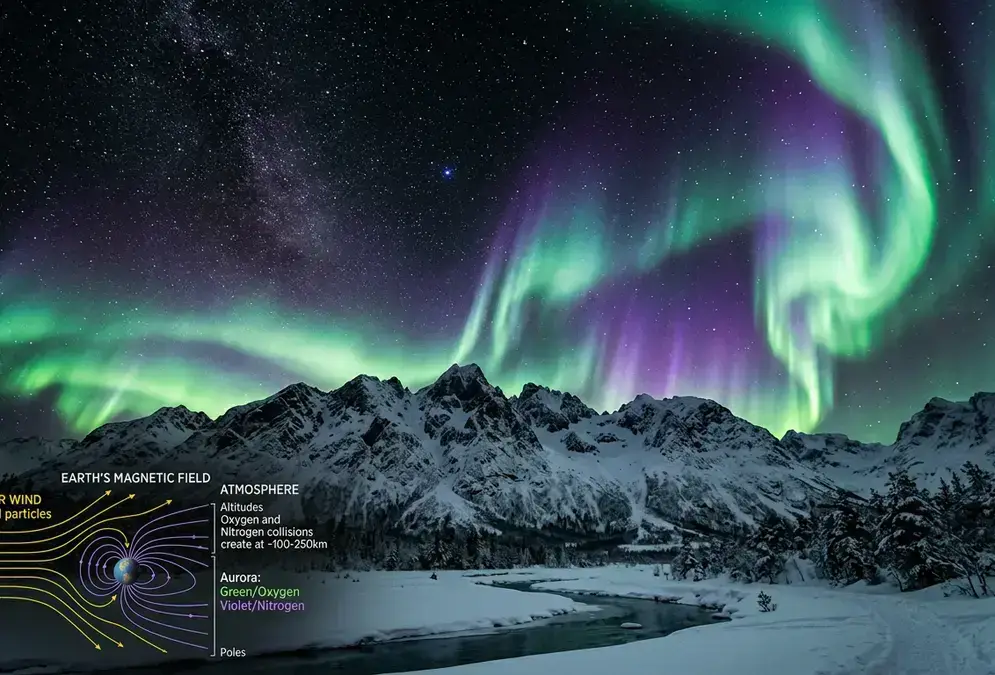
Green and violet auroral curtains rippling above a snow-covered mountain silhouette at night, illustrating what causes the northern lights through solar wind particles colliding with Earth's upper atmosphere.

Featured · Article

What Causes the Northern Lights? The Science Explained

Solar wind collides with Earth's magnetic field, funneling charged particles toward the poles, where they excite oxygen and nitrogen into glowing color.

Two habits close most of the gap. Let your eyes adapt, which is the whole point of red light and dark adaptation, then look slightly to one side so averted vision puts the faint light on the more sensitive part of the retina. A pair of binoculars for stargazing is the sensible way to confirm either galaxy before you trust your eyes.

Farthest depends on the rules, and how to try it

Change any word in the claim and the record moves. A gamma-ray burst in 2008, GRB 080319B, peaked at magnitude 5.8 and stayed visible to human eyes for about 30 seconds from roughly 7.5 billion light-years away[22]. It dwarfs Andromeda's distance, and no one can book a night to see one.

Before you go looking for Andromeda

  • Pick a clear, moonless night; moonlight washes out faint galaxies.
  • Get as far from town lights as you can, because skyglow matters more than eyesight.
  • Give your eyes time to adapt, and use red light only.
  • Look slightly beside the galaxy rather than straight at it.
  • Bring binoculars to confirm what you think you see.
  • Expect a faint oval smudge, not a photograph.
For the permanent record, the plan is mostly about the sky. A site that earns a good dark-sky rating matters more than your eyesight, which is why the sites in the guide to the best places to see the Milky Way are where I would start. If you are new to this, treat the first attempt as calibration: finding it once tells you what your own sky and eyes can do.

Recommended tours

Tours are selected for quality, not commission. I earn a small fee if you book — at no extra cost to you.

Expect an elongated smudge, not the swirled disk in photographs. Seeing it anyway, with nothing between you and a light that left 2.5 million years ago[9], is the point of the exercise.

Frequently asked questions

What is the farthest thing you can see with the naked eye?

For a permanent object that most people can reliably see, it is the Andromeda Galaxy (M31), about 2.5 million light-years away, and only from a reasonably dark sky. Triangulum (M33) is slightly farther but needs far better conditions, and a gamma-ray burst in 2008 was briefly visible from billions of light-years away.

Can you see Andromeda without a telescope?

Yes, as a faint, elongated smudge, provided the sky is dark enough. Bortle's descriptions have it visible but not prominent at class 6, barely visible at class 7, barely glimpsed at class 8 and invisible at class 9.

How old is the light from Andromeda?

About 2.5 million years, because the galaxy is about 2.5 million light-years away. The Sun's light, for comparison, is about 8.3 minutes old when it reaches you.

What Bortle class do you need to see Andromeda?

No published class marks where it first appears. Bortle's descriptions of M31 start at class 6, where it is visible but not prominent, so aim for a sky darker than that and use binoculars to confirm. How much easier a darker sky makes it depends on your eyes and the night.

Can you see the Triangulum Galaxy with the naked eye?

Sometimes. Bortle says a fully dark-adapted observer should manage it under class 4 skies or better. EarthSky rates Andromeda eight times brighter in our sky than Triangulum, and although M33 is rated sixth magnitude it has very low surface brightness, being large and almost face-on, so treat class 4 as the best case. Averted vision and binoculars help.

Is anything farther than Andromeda visible to the naked eye?

Only briefly. Triangulum is a little farther and a hard target. The 2008 gamma-ray burst GRB 080319B reached magnitude 5.8 and stayed visible for about 30 seconds from roughly 7.5 billion light-years away, but nothing like that can be planned for.

Sources

22 references Show
  1. earthsky.org — Andromeda galaxy closest spiral to milky way (opens in a new tab)

    “And, at 2.5 million light-years, it’s the most distant thing we humans can comfortably see with the unaided eye.”

  2. Wikipedia — Triangulum Galaxy (opens in a new tab)

    “to those viewers, it is the farthest permanent entity visible without magnification, being about 2.88 million lightyears from Earth.”

  3. earthsky.org — Triangulum galaxy m33 a binocular challenge (opens in a new tab)

    “But, in practice, you’ll need perfect dark sky conditions – and good eyesight – to see it with the eye alone.”

  4. Wikipedia — Bortle scale (opens in a new tab)

    “A NELM of 6.0 to 6.5 is a more commonly cited figure.”

  5. public.nrao.edu (opens in a new tab)

    “For the Sun, its light takes about 8.3 minutes to reach us, so we always see the Sun as it was 8.3 minutes ago.”

  6. Wikipedia — Andromeda Galaxy (opens in a new tab)

    “Under most viewing conditions, the Andromeda Galaxy is one of the most distant objects that can be seen with the naked eye, due to its sheer size.”

  7. earthsky.org — Andromeda galaxy closest spiral to milky way (opens in a new tab)

    “In a dark sky, you can see that it appears large on the sky as well; it’s a smudge of distant light larger than a full moon.”

  8. science.nasa.gov (opens in a new tab)

    “Located 2.5 million light-years away, the majestic Andromeda galaxy appears to the naked eye as a faint, spindle-shaped object roughly the angular size of the full Moon.”

  9. public.nrao.edu (opens in a new tab)

    “The Andromeda galaxy is about 2.5 million light years away, so we see it as it was 2.5 million years ago.”

  10. public.nrao.edu (opens in a new tab)

    “If we assume that Andromeda has been moving at that same speed and direction for the past 2.5 million years, then in that time it has traveled about 900 light years closer to us.”

  11. astronomy.com — 101 must see cosmic objects the andromeda galaxy (opens in a new tab)

    “In 1923, Edwin Hubble calculated the distance to M31 at 1 million light-years.”

  12. covingtoninnovations.com (opens in a new tab)

    “M31, M44 visible to naked eye but not prominent.”

  13. covingtoninnovations.com (opens in a new tab)

    “M44, M31 barely visible without a telescope.”

  14. planesynormas.mma.gob.cl (opens in a new tab)

    “M31 and M44 may be barely glimpsed by an experienced observer on good nights”

  15. nps.gov (opens in a new tab)

    “Under the most polluted conditions (9 on the Bortle Scale) the Andromeda Galaxy (a nebula adjacent to the constellation Andromeda, appropriately) cannot be seen at all.”

  16. Wikipedia — Andromeda Galaxy (opens in a new tab)

    “With an apparent magnitude of 3.44, the Andromeda Galaxy is among the brightest of the Messier objects”

  17. Wikipedia — Bortle scale (opens in a new tab)

    “Diffuse light sources such as M33 are more difficult to see than point light sources of the same visual magnitude”

  18. earthsky.org — Andromeda galaxy closest spiral to milky way (opens in a new tab)

    “You might argue the large spiral Triangulum Galaxy is slightly more distant at 2.7 million light-years, and sometimes visible to the eye too.”

  19. astronomy.com — 101 must see cosmic objects the triangulum galaxy (opens in a new tab)

    “Even though it is rated at 6th magnitude, M33 has a very low surface brightness due to its large apparent diameter in our sky.”

  20. planesynormas.mma.gob.cl (opens in a new tab)

    “A fully dark adapted ob-server should be able to spot it under skies good enough to rate Class 4 or better on the Bortle scale.”

  21. nps.gov (opens in a new tab)

    “A night sky rates a 1 if the Triangulum Galaxy (a nebula next to the constellation Triangulum) can be seen by looking directly at it.”

  22. Wikipedia — GRB 080319B (opens in a new tab)

    “it had a peak visual apparent magnitude of 5.8 and remained visible to human eyes for approximately 30 seconds.”