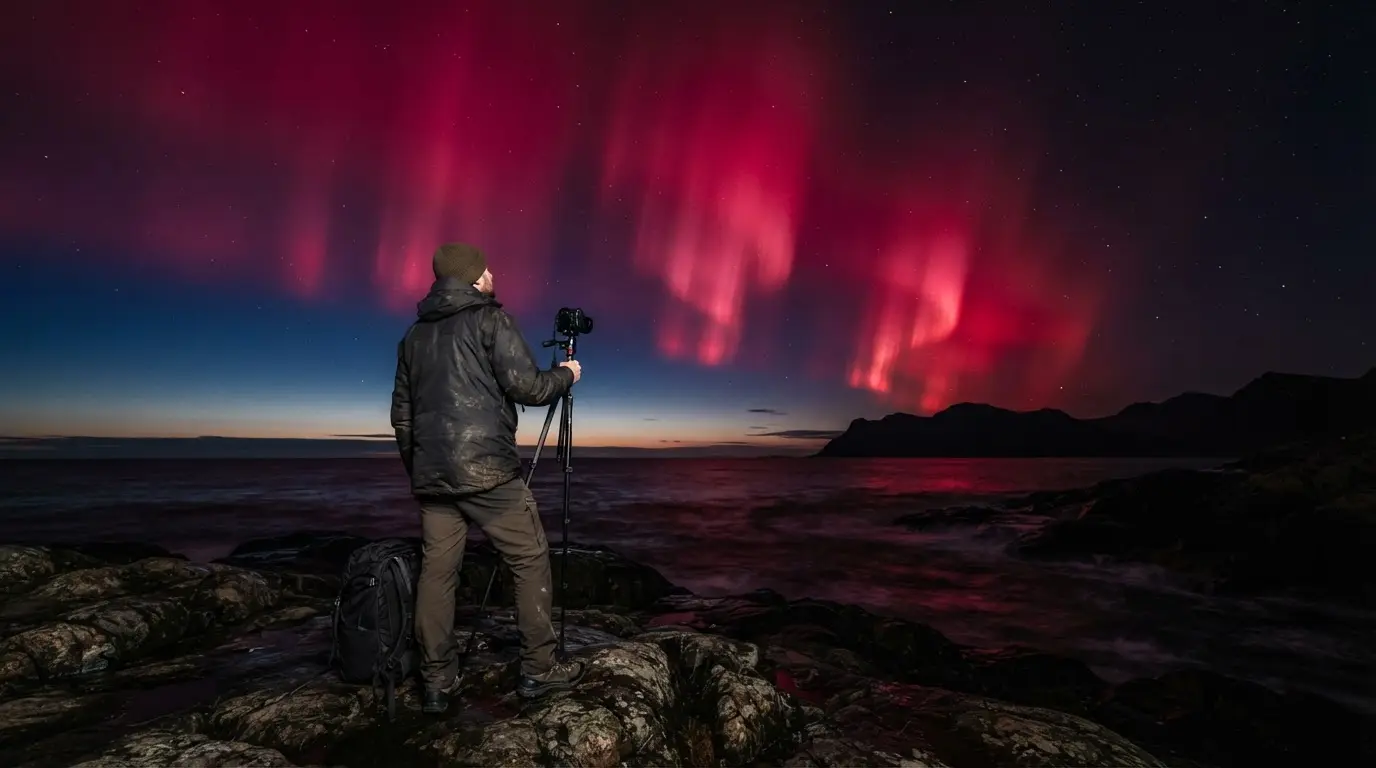
Photographer on a dark shoreline watches crimson aurora over the sea, like Carrington Event 1859 reports

Carrington Event 1859: The Night Aurora Reached Cuba

The Carrington Event of 1859 sent aurora to Cuba and fooled Rocky Mountain miners into making breakfast at 1 a.m. Here is what a repeat would do today.

Portrait of Maya Okonkwo
Written by

I've seen dark skies firsthand in the Atacama altiplano, Namibia's NamibRand Nature Reserve, and Morocco's Merzouga dunes; every other destination I write about is built from measured Bortle and SQM data, cloud climatology, and primary sources like park services and the International Dark-Sky Association.

Published
One night in September 1859, at about 1 a.m., Rocky Mountain gold miners got up and cooked breakfast, thinking the Sun had risen on a cloudy morning[1]. It was aurora, and the storm behind it pushed northern lights as far south as Cuba[2], which is why the Carrington Event is still the benchmark: no geomagnetic storm on record has been larger[3]. The lights were the harmless part; the damage came through the wires, which is why a trip plan should assume several nights at high latitude and a live reading rather than a forecast made a week out.
Sun-to-Earth transit
17.6 hours
The CME crossed roughly 150 million km to reach Earth[4]
Aurora geomagnetic latitude
~18°
Reached on 2-3 September, after about 25° on 28-29 August[5]
Riley's odds per decade
12%
2014 estimate for a Carrington-class hit within ten years[6]

A sunspot group, two observers and a flash at 11 a.m.

On 1 September 1859, Richard Carrington was observing a large sunspot group when a sudden flash of intense white light burst out of it, around 11:00 AM[7]. Richard Hodgson, watching the same group independently, saw it too, and between them the two men were the first to record a white-light flare[8]. Carrington noted that a geomagnetic storm followed but would not claim the two were connected[9].
That caution was reasonable. What reached Earth was a coronal mass ejection from the same region, and it crossed roughly 150 million km in 17.6 hours[4], a trip that normally takes days. Nobody in 1859 had a mechanism to link the two, because the first optical observation of a CME came only in December 1971, from the OSO-7 coronagraph[10].
The Sun was not even at its busiest. Solar Cycle 10 did not peak until February 1860, months after the storm[11].
The record of that week breaks into three dated episodes:
  • 28-29 August: the first storm, with aurora down to about 25° geomagnetic latitude[5]
  • 1 September, about 11:00 AM: Carrington and Hodgson see the flare[7]
  • 2-3 September: the second storm and the crimson sky, down to about 18°[5]

Two storms, one crimson sky

There were two storms, not one, days apart, so a watcher in the tropics got two chances and the second night ran longer and reached lower latitudes. Physicist Pete Riley thinks the 1859 event likely involved multiple eruptions, which may be a key requirement for storms this extreme[12].
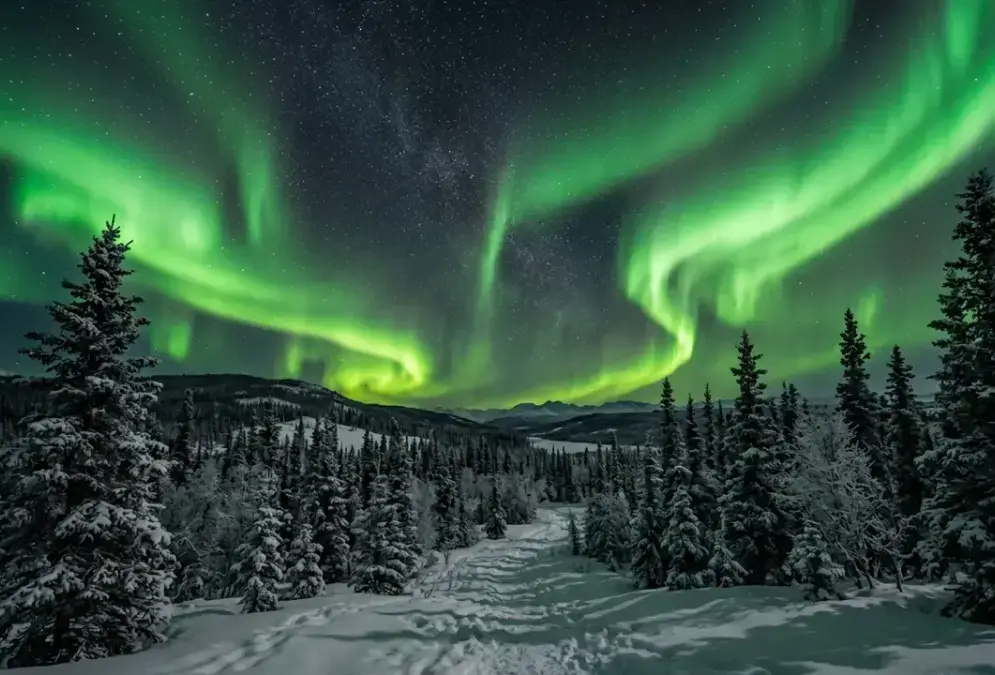
Green aurora borealis ribbons over a snow-covered black spruce forest near Fairbanks, Alaska, with a faint band of stars visible through the curtain of light

Featured · Destination

Fairbanks Northern Lights

Fairbanks sits directly under the auroral oval at 64.8°N. Aurora season runs Aug 21–Apr 21, peaking Feb–Mar, with roughly 90% odds if you stay 3+ nights.

Geomagnetic latitude counts from the magnetic pole rather than the geographic one, so 18° is not a street-map figure. It is still nowhere near the auroral oval where aurora normally lives.
The ground truth is in the logs. US Navy ships recorded the aurora off Central America, the Sabine noting it at 11°14′N around 12:30 AM on 2 September[13], and northern lights reached as far south as Cuba[2]. Accounts relayed from National Geographic add Honolulu, now better known for Mauna Kea stargazing, and southern lights as far north as Santiago, Chile[14].
What people remembered was the colour, a blood or deep crimson red bright enough to read a newspaper by[15]. The display also lasted: below 50° latitude, auroral forms of every type and colour showed for about 24 hours on 28-29 August and about 42 hours on 2-3 September[16].

Telegraph wires that sparked and doorknobs that shocked

The telegraph was the high-tech network of 1859, and the storm found its way into the wires. Surges ran through the world's telegraph systems until no one could send a message[17], some lines sparked badly enough to set telegraph offices on fire[2], and of the roughly 200,000 km of line then in service worldwide, a large share was knocked out, many stretches for eight hours or more, at real economic cost[18].
People felt it too. Stories circulated of shocks from doorknobs and other metal objects as currents were induced in them[19]. The mechanism still works: a long conductor under a disturbed magnetic field carries current it was never built for, which is the threat to modern grids, and to GPS and radio as well[20].

Could a Carrington-class storm happen again?
It almost did on 23 July 2012. A powerful CME tore through Earth's orbit and struck the STEREO-A spacecraft instead[22]. Had the eruption come a week earlier, Earth would have been in the line of fire[23]. Dst, the index that measures how far a storm depresses Earth's magnetic field, would have hit about −1200 in that storm, comparable to Carrington[24].
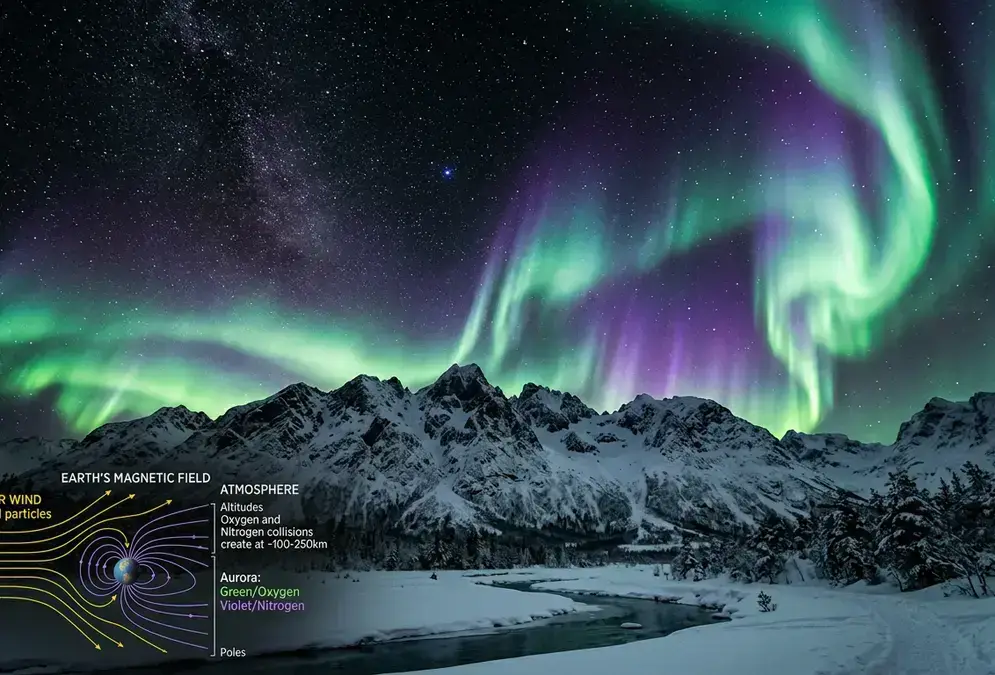
Green and violet auroral curtains rippling above a snow-covered mountain silhouette at night, illustrating what causes the northern lights through solar wind particles colliding with Earth's upper atmosphere.

Featured · Article

What Causes the Northern Lights? The Science Explained

Solar wind collides with Earth's magnetic field, funneling charged particles toward the poles, where they excite oxygen and nitrogen into glowing color.

That puts the 1859 number in context. Modern estimates of its Dst run from −800 nT to −1750 nT[25], against −600 nT for the March 1989 storm that knocked out power across Quebec[26]. Dst is a different scale from the Kp index aurora apps show: Kp rates how disturbed the field is on a 0 to 9 scale, Dst how hard it is pushed down.
How often? NOAA's figure for 1859-scale storms is roughly one per 500 years, with half-strength storms every 50 years or so[27]. The Sun keeps no schedule, though. Cycle 10's modest peak shows it can produce such an event during almost any solar cycle[28].

What a repeat would mean for travelers and the grid

A repeat would be a problem before it was a spectacle. NOAA's assessment is that a storm of that class could cripple satellites and communications and cause blackouts over whole continents[30]. A 2009 National Academy of Sciences report on the knock-on effects found perishable food and medicine would spoil within 12 to 24 hours, with heating, sewage handling, phone service and refuelling failing alongside[31].

Recommended tours

Tours are selected for quality, not commission. I earn a small fee if you book — at no extra cost to you.

Hardware has taken smaller hits already. In February 2022, 38 of 49 freshly launched SpaceX Starlink satellites were lost to extra atmospheric drag after a geomagnetic storm[32], and one report on the October and November storms of 2003 links them to transformer failures in North America and Europe[33]. A Lloyd's estimate puts a Carrington-class event at between $0.6 and $2.6 trillion in damage to the US alone[34], and a National Academy of Sciences study cited by NASA puts the total economic impact above $2 trillion, some 20 times the cost of Hurricane Katrina[35]. NOAA keeps its GOES-R solar monitors some 22,300 miles out, far beyond the orbit of most satellites[36].

How far south the oval moves, and what it does to your kit

You do not need 1859 to see the lights move south. A G1 storm (Kp 5) shows aurora commonly at high latitudes such as northern Michigan and Maine[37], a G3 (Kp 7) as low as Illinois and Oregon, about 50° geomagnetic latitude[38], a G4 as low as Alabama and northern California[39], and a G5 as low as Florida and southern Texas[40]. The rule of thumb behind those steps: the oval's equatorward edge sits near 66° at Kp 0 and moves about 2° equatorward per Kp step[41].
The bigger the storm, the more of your kit it touches. In a severe storm, single-frequency GPS errors can grow from a meter or less to tens of meters or more[42], and a highly disturbed ionosphere can stop a receiver locking on at all[43]. HF radio, used by commercial airlines among others, can be modified or blocked completely[44], and the extra upper-atmosphere heating adds drag on low-Earth-orbit satellites[45].

Planning an aurora trip around an unpredictable Sun

Timing matters as much as storm size. The best seasons for aurora watching are around the spring and fall equinoxes[46], the best aurora usually falls within an hour or two of midnight, between 10 PM and 2 AM local time[47], and in summer at auroral latitudes the midnight sun prevents observation altogether[48].
For a trip, the lesson is narrower than the headlines. CMEs cannot yet be predicted and nobody knows in advance which ones are dangerous[29], so the plan that works is the ordinary one: a high-latitude base for the whole aurora season, with a week of margin for cloud. I haven't stood under a Tromsø aurora yet; the Tromsø trip I keep costing out is eight nights, not one, for exactly this reason. Install one of the best aurora forecast apps before you go and trust a live reading over any forecast made a week out.
I would also skip any tour that sells a storm night as a guaranteed product. Nobody can schedule a storm, and the 1859 record shows the sky does what it likes: two nights of lights days apart, one of them reaching the tropics, neither of them forecast by anyone.

Frequently asked questions

How far south was the aurora during the Carrington Event 1859?

By geomagnetic latitude the aurora reached about 18° on 2-3 September[5]. On the ground that meant US Navy ship logs off Central America near 11° N[13] and northern lights as far south as Cuba[2].

What caused the Carrington Event?

A coronal mass ejection from the sunspot region where Richard Carrington and Richard Hodgson saw a white-light flare on 1 September 1859[8]. The cloud reached Earth in about 17.6 hours[4], and physicist Pete Riley thinks more than one eruption was involved[12].

Why is it called the Carrington Event?

It is named for Richard Carrington, who with Hodgson was first to observe a white-light flare, on 1 September 1859[8]. Carrington noted the storm that followed but did not claim a direct link[9].

Could a Carrington-class solar storm happen again?

Yes, and the estimates differ. NOAA puts 1859-scale storms at about one every 500 years[27], while Pete Riley's 2014 calculation gave a 12% chance within ten years[6]. A July 2012 CME hit the STEREO-A spacecraft instead; a week earlier it would have reached Earth[22][23].

What would a Carrington-level storm do today?

NOAA warns it could severely damage satellites, disrupt communications and black out whole continents[30]. A National Academy of Sciences report found perishable food and medication would be lost within 12 to 24 hours[31].

Was the 1859 aurora seen in Hawaii and Chile?

Accounts citing National Geographic say northern lights were seen from Honolulu and southern lights as far north as Santiago, Chile[14].

Is a solar storm dangerous to people on the ground?

The documented risk is to technology rather than to people outdoors: induced currents in long power lines can disrupt grids, and satellites, GPS and radio can suffer too[20].

Sources

48 references Show
  1. nesdis.noaa.gov (opens in a new tab)

    “Gold miners in the Rocky Mountains wake up and make coffee, bacon and eggs at 1:00 AM, thinking the Sun has risen on a cloudy morning.”

  2. science.nasa.gov (opens in a new tab)

    “Intense geomagnetic storms ignited Northern Lights as far south as Cuba and caused global telegraph lines to spark, setting fire to some telegraph offices”

  3. Britannica (opens in a new tab)

    “geomagnetic storm of 1859, largest geomagnetic storm ever recorded.”

  4. space.com (opens in a new tab)

    “In 17.6 hours, the CME traversed over 90 million miles (150 million km) between the sun and Earth and unleashed its force on our planet.”

  5. pmc.ncbi.nlm.nih.gov (opens in a new tab)

    “The aurora was observed to reach extremely low geomagnetic latitudes on August 28–29 (~25°) and on September 2–3 (~18°).”

  6. science.nasa.gov (opens in a new tab)

    “he calculated the odds that a Carrington-class storm would hit Earth in the next ten years. The answer: 12%.”

  7. nesdis.noaa.gov (opens in a new tab)

    “Around 11:00 AM, he sees a sudden flash of intense white light from the area of the sunspots.”

  8. pmc.ncbi.nlm.nih.gov (opens in a new tab)

    “On September 1, 1859, Richard Carrington and Richard Hodgson, while observing a large sunspot group independently, were the first to observe a white light flare”

  9. Britannica (opens in a new tab)

    “Carrington noted the coincidence (but did not claim a direct connection) between the geomagnetic storm and the solar flare”

  10. Wikipedia — Coronal mass ejection (opens in a new tab)

    “The first optical observation of a CME was made on 14 December 1971 using the coronagraph of Orbiting Solar Observatory 7 (OSO-7).”

  11. earthsky.org (opens in a new tab)

    “we know that the peak of Solar Cycle 10 was in February 1860. The Carrington Event happened just months earlier, in September 1859.”

  12. science.nasa.gov (opens in a new tab)

    “It's likely that the Carrington event was also associated with multiple eruptions, and this may turn out to be a key requirement for extreme events,”

  13. pmc.ncbi.nlm.nih.gov (opens in a new tab)

    “| Sabine | September 2 | 12:30 AM | 11° 14′19″N | 83°49′30″W | RG24 |”

  14. space.com (opens in a new tab)

    “The northern lights (aurora borealis) were witnessed as far south as Cuba and Honolulu, Hawaii, whilst the southern lights (aurora australis) were seen as far north as Santiago, Chile”

  15. pmc.ncbi.nlm.nih.gov (opens in a new tab)

    “the aurora was described as a blood or deep crimson red that was so bright that one “could read a newspaper by.””

  16. pmc.ncbi.nlm.nih.gov (opens in a new tab)

    “Auroral forms of all types and colors were observed below 50° latitude for ~24 h on August 28–29 and ~42 h on September 2–3.”

  17. nesdis.noaa.gov (opens in a new tab)

    “Spikes of electricity surge into the world's telegraph systems, and no one can send a message.”

  18. pmc.ncbi.nlm.nih.gov (opens in a new tab)

    “A significant portion of the world’s 200,000 km of telegraph lines were adversely affected, many of which were unusable for 8 h or more which had a real economic impact.”

  19. earthsky.org (opens in a new tab)

    “There were widespread stories of people receiving shocks from doorknobs and other metal objects, thanks to the induction of electrical currents.”

  20. space.com (opens in a new tab)

    “Strong geomagnetic storms can disrupt satellites, GPS, radio systems and even electrical power grids by inducing currents in long power lines.”

  21. space.com (opens in a new tab)

    “they could however unplug their batteries and transmit messages to Portland, Maine, using only the auroral current according to Ars Technica.”

  22. science.nasa.gov (opens in a new tab)

    “describes how a powerful coronal mass ejection (CME) tore through Earth orbit on July 23, 2012. Fortunately Earth wasn't there. Instead, the storm cloud hit the STEREO-A spacecraft.”

  23. science.nasa.gov (opens in a new tab)

    “If the eruption had occurred only one week earlier, Earth would have been in the line of fire.”

  24. science.nasa.gov (opens in a new tab)

    “the resulting geomagnetic storm would have registered a Dst of -1200, comparable to the Carrington Event and twice as bad as the March 1989 Quebec blackout.”

  25. science.nasa.gov (opens in a new tab)

    “Modern estimates of Dst for the Carrington Event itself range from -800 nT to a staggering -1750 nT.”

  26. science.nasa.gov (opens in a new tab)

    “The worst geomagnetic storm of the Space Age, which knocked out power across Quebec in March 1989, registered Dst=-600 nT.”

  27. nesdis.noaa.gov (opens in a new tab)

    “Solar storms like the one in 1859 happen only about every 500 years—thankfully. But smaller storms happen frequently, and storms half as intense as the 1859 storm happen about every 50 years.”

  28. pmc.ncbi.nlm.nih.gov (opens in a new tab)

    “This indicates that the sun is capable of producing solar wind conditions (e.g., CME) necessary to produce a comparable auroral event during almost any solar cycle.”

  29. earthsky.org (opens in a new tab)

    “But when the sun releases a CME, it’s difficult to work out exactly how much material will hit us. Put simply, we don’t know which ones are the dangerous ones.”

  30. nesdis.noaa.gov (opens in a new tab)

    “Today, such a storm could severely damage satellites, disable communications by telephone, radio, and TV, and cause electrical blackouts over whole continents.”

  31. pbs.org (opens in a new tab)

    “perishable foods and medications lost in 12-24 hours; loss of heating/air conditioning, sewage disposal, phone service, fuel re-supply and so on,”

  32. Wikipedia — Starlink (opens in a new tab)

    “After the event, 38 satellites reentered the atmosphere by February 12 while the remaining 11 were able to raise their orbits and avoid loss due to the storm.”

  33. pbs.org (opens in a new tab)

    “storms in October and November in 2003 caused transformer failures in North America and Europe.”

  34. space.com (opens in a new tab)

    “a Carrington-class event today would result in between $0.6 and $2.6 trillion in damages to the U.S. alone”

  35. science.nasa.gov (opens in a new tab)

    “the total economic impact could exceed $2 trillion or 20 times greater than the costs of a Hurricane Katrina.”

  36. nesdis.noaa.gov (opens in a new tab)

    “While most satellites are just a few hundred miles above Earth, the GOES-R series satellites are 22,300 miles out in space.”

  37. spaceweather.gov — Noaa scales explanation (opens in a new tab)

    “aurora is commonly visible at high latitudes (northern Michigan and Maine).”

  38. spaceweather.gov — Noaa scales explanation (opens in a new tab)

    “HF radio may be intermittent, and aurora has been seen as low as Illinois and Oregon (typically 50° geomagnetic lat.).”

  39. spaceweather.gov — Noaa scales explanation (opens in a new tab)

    “satellite navigation degraded for hours, low-frequency radio navigation disrupted, and aurora has been seen as low as Alabama and northern California (typically 45° geomagnetic lat.).”

  40. spaceweather.gov — Noaa scales explanation (opens in a new tab)

    “HF (high frequency) radio propagation may be impossible in many areas for one to two days, satellite navigation may be degraded for days, low-frequency radio navigation can be out for hours, and aurora has been seen as low as Florida and southern Texas (typically 40° geomagnetic lat.).”

  41. spaceweather.gov — Tips viewing aurora (opens in a new tab)

    “At Kp = 0, the equator ward edge of the auroral oval is approximately 66 degrees. And it moves equatorward about 2 degrees for each level of Kp.”

  42. spaceweather.gov — Space weather and gps systems (opens in a new tab)

    “In calm conditions, single frequency GPS systems can provide position information with an accuracy of a meter or less. During a severe space weather storm, these errors can increase to tens of meters or more.”

  43. spaceweather.gov — Space weather and gps systems (opens in a new tab)

    “But when the ionosphere becomes highly disturbed, the GPS receiver cannot lock on the satellite signal and position information becomes inaccurate.”

  44. spaceweather.gov — Hf radio communications (opens in a new tab)

    “These frequencies are used by amateur (ham) radio operators and many industries such as commercial airlines.”

  45. spaceweather.gov — Geomagnetic storms (opens in a new tab)

    “causing extra drag on satellites in low-earth orbit.”

  46. spaceweather.gov — Tips viewing aurora (opens in a new tab)

    “The best Seasons for aurora watching are around the spring and fall equinoxes.”

  47. spaceweather.gov — Tips viewing aurora (opens in a new tab)

    “Best aurora is usually within an hour or two of midnight (between 10 PM and 2 AM local time).”

  48. spaceweather.gov — Aurora (opens in a new tab)

    “It must also be dark so during the summer months at auroral latitudes, the midnight sun prevents auroral observations.”