All articles
Written by Maya Okonkwo
  • 4 min
  • 21 sources

Orcas, Humpbacks, and Aurora in the Same Tromsø Week

Orcas and humpbacks reach the fjords north of Tromsø from late October. Here is how that season overlaps the aurora, and where January starts to cut it short.
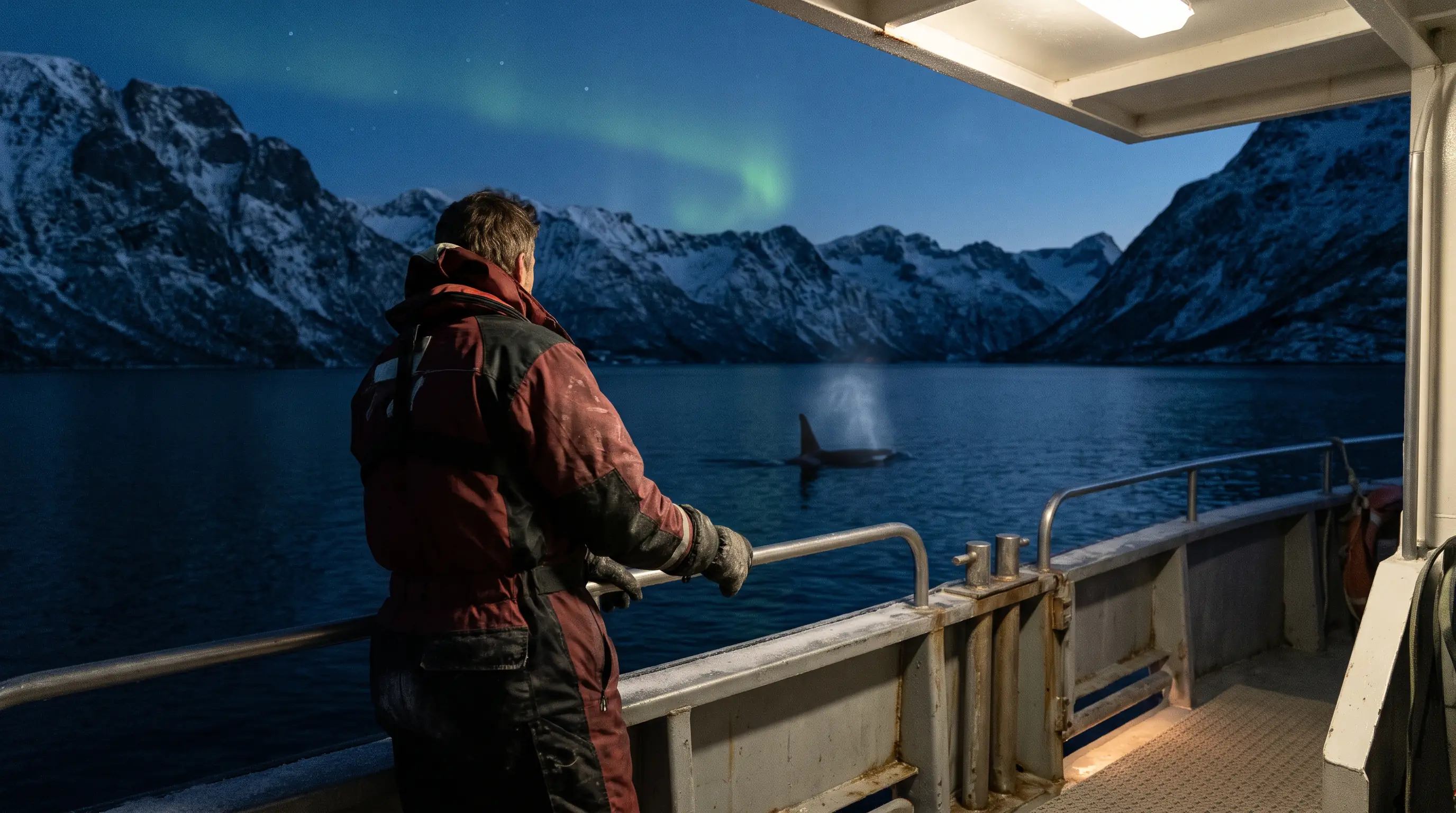
Orcas surfacing in a snow-ringed Norwegian fjord at blue hour with a faint green aurora above the ridge, the whale watching and northern lights tromso same trip pairing

A whale cruise from Tromsø to the Skjervøy feeding grounds runs about 7–8 hours, which is why it rarely shares a day with an aurora night.

One winter trip to Tromsø can hold orcas, humpbacks and the aurora, and the window to book is November, for a full week: the whales arrive in late October and stay into January, while the aurora season outlasts them by months. The overlap is thin, though, since a whale cruise is a 7–8 hour boat day[1], the sun stays below the horizon from 27 November to 15 January[2], and the sky over Tromsø is overcast or mostly cloudy about 79% of the time in December[3]. A week leaves slack for cruises cancelled in rough seas and nights lost to cloud, and because the whales leave first, January is the month to be careful with.
Whale cruise from Tromsø
7–8 hours
Approximate length of the Tromsø to Skjervøy cruise[1]
Tromsø polar night
27 Nov–15 Jan
Sun stays below the horizon, per Norway's weather service[2]
December cloud cover
79%
Tromsø Airport sky overcast or mostly cloudy, December average[3]

Why the whales are north of Tromsø at all
Orcas and humpbacks come to northern Norway's fjords for the herring, not the scenery. The winter shoals gather in the fjords around Skjervøy, which puts the action well north of Tromsø's harbour, and the whales feed where the fish are[4]. The herring start arriving in late October, and hundreds of orcas, humpbacks and fin whales trail in behind them[5].
The arrangement is younger than most trip reports imply. Part of the Norwegian spring-spawning herring stock began wintering in the Kvænangen fjord system in 2017-2018 and was still there in 2024-2025[6], and whales have come to Skjervøy every year since the herring moved north from the coast off Tromsø in the winter of 2017[7]. Before that, the fish were nearer town than they are now.
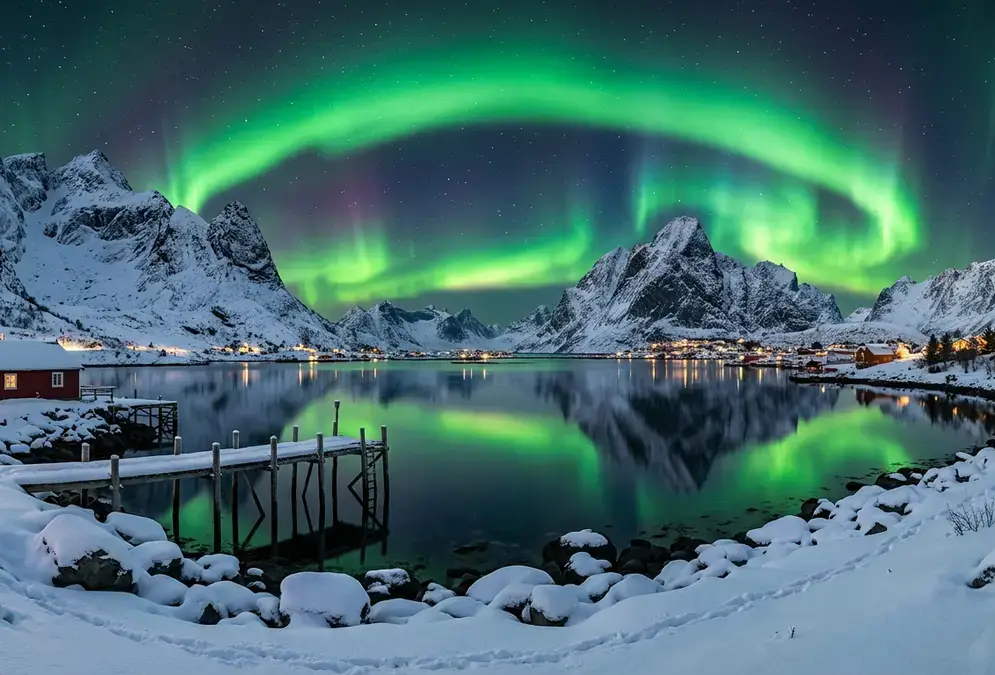
Green aurora borealis arching over a snow-covered fjord near Tromsø, Norway, with mountain silhouettes and calm water reflections during polar night

Featured · Destination

Northern Lights in Tromsø

At 69.6°N inside the auroral oval, Tromsø sees aurora at Kp 2. Peak season November–February. Best viewing spots, tour advice, and aurora forecast strategy.

That leaves a trip with two different clocks. The northern lights in Tromsø run on a calendar of darkness and geomagnetic odds, while the whale season is a fish calendar, and that calendar has already moved once.

Month by month, where the two seasons overlap

Every month the whales are in the fjords is also an aurora month, but the reverse is not true, so the whale season sets the window. It opens in late October and closes somewhere between mid-January and early February, depending on where you draw the line: the feeding season off Skjervøy runs from October to early February[8], the whale-safari high season from October to January[9], and the main season for humpbacks in the fjords from November to January[10]. November and December sit inside all three.
The aurora side is the long one: the lights may be visible from late August to early April[11], and organised tours usually run from September to early April[12]. That makes late October an early-season bet, since the herring are only just arriving, and the second half of January a bonus rather than a plan. Laid out by month, only the whale column ever goes blank.
PeriodWhales north of TromsøAurora from Tromsø
Late August to SeptemberNot yet; the herring have not entered the fjordsSeason open; organised tours start in September
OctoberOpens in late October as the herring move inOpen
NovemberMain season; inside every published windowOpen; the polar night begins at month's end
DecemberMain season; humpbacks begin to leaveOpen; cloud is the main risk
JanuaryThinning; ends between mid-January and early FebruaryOpen
FebruaryTail end at best; herring heading for the spawning groundsOpen
March to early AprilOverOpen until early April
The whale watching tour from Tromsø leaves at 08:30[13] and runs north to the feeding grounds around Skjervøy, which is why it consumes most of a day rather than a morning. Treat it as the one daytime commitment of the week and fit the sky around it.

What shrinks the overlap before the aurora does

Humpbacks leave on their own schedule: most depart Norway between December and late January[14], so a trip in the last days of January is a bet on the stragglers. Whales that came for herring also tend to go when the herring do, and the herring have moved before.
Where the fish sit inside a winter matters too. A December 2024 acoustic survey recorded insignificant herring around Hammerfest, outer Kvænangen, Lopphavet and west of Skjervøy[15], a reminder that "around Skjervøy" names a region rather than a fixed spot.

Recommended tours

Tours are selected for quality, not commission. I earn a small fee if you book — at no extra cost to you.
By late January 2026 the herring fishery was working inside Altafjorden, west of Sørøya and about 15 nautical miles northwest of Torsvåg lighthouse[16], and in the first half of February the catch indicated the herring were leaving the wintering areas north of Tromsø for the spawning grounds[17]. A fish report is not a whale count, so I read it as a warning about late January rather than a measurement: book the whale day for before the herring start to leave.

Sequencing a whale day and an aurora night

Give each its own day. On paper one day can hold both, since the boat is back in the afternoon and the aurora is most often active between roughly 20:00 and 02:00[18], but a 7–8 hour day on open water[1] followed by a night in the cold is one day too many for most people. I would not plan it as the default.
Daylight is the constraint on the whale half. Tromsø's polar night, when the sun stays below the horizon, runs from 27 November to 15 January[2], and on clear days there is still some daylight around midday[19]. A cruise in the first half of November therefore has more light to work with than one in mid-December, and the polar night is better spent on the sky than on the water.
Cloud is the risk on the aurora half. Over Tromsø Airport the sky is overcast or mostly cloudy about 79% of the time in December[3], which is why how many nights you book matters more than which week you pick.
The whale half has weather of its own. Operators cancel and refund when the sea is too rough[20], so a whale day needs a spare day behind it.

Keep the boat off your last day

A cruise cancelled for rough water has nowhere to go if it lands on the day you fly. Put the whale day early in the week, the chase night after it, and leave the last full day empty.

Which weeks to book if you want both

November, for a full week, is the window I would cost first. A week is the number that covers both halves of the problem, since whale cruises get cancelled for rough seas and aurora nights get lost to cloud[21]. After that the choice runs along the calendar:
  • Late October to mid-November: whales arriving, the aurora fully open, and the most daylight of any overlap month; the first week of the whale season is the least certain part.
  • Late November to mid-December: the whale season at full strength, the polar night under way, humpbacks starting to leave, and the longest nights the aurora gets.
  • January: whales thinning and the herring close to leaving, so plan around the aurora and treat a whale day as a bonus.
  • February to early April: aurora only.
Traveler photographing the Milky Way arc above a dark desert horizon on an astrotourism trip, tripod-mounted camera capturing star trails against a certified dark-sky park backdrop

Featured · Article

What Is Astrotourism? The Complete Beginner's Guide

Astrotourism means travel built around dark skies: meteor showers, auroras, the Milky Way. What it means, where to go, and how to plan your first trip.

I haven't seen an aurora in person yet, so this is a plan I have costed rather than a trip report. In my version the week is built around the aurora margin, with a single northern lights chase tour as insurance against a bad local forecast, and I would not pay for a guaranteed-sighting tour at all. The whale cruise then competes with every other one of the daytime options in Tromsø beyond the aurora, and at 7–8 hours it is among the longest of them.

Frequently asked questions

Can you do whale watching and see the northern lights in Tromsø on the same trip?

Yes, from late October to January, when the whale season and the aurora season overlap. Give the whale cruise a day to itself and keep a spare night or two for the aurora, because a week of slack matters more than the exact dates.

When is whale watching season in Tromsø?

The orcas and humpbacks feeding on herring north of Tromsø are there from late October into January, tailing off between mid-January and early February. Most humpbacks leave between December and late January, which makes November and December the safest months.

Can you see the northern lights on a whale watching tour from Tromsø?

Occasionally, if the sky clears on the way home, because a cruise that leaves at 08:30 and runs 7–8 hours finishes as the light fades. Treat it as a bonus rather than the aurora plan.

Is November or January better for whales and northern lights?

November, for the whales: it sits inside every published season window and the humpbacks have not started to leave. January is the better choice only when the aurora is the real goal and a whale day is a bonus before the herring move out.

Do whale cruises run during the polar night?

Yes. The whale season straddles the polar night, which runs from 27 November to 15 January, and the boats work in the limited midday light that clear days still bring. Expect short days rather than none.

Are whale sightings guaranteed in Tromsø?

No. Whales are wild animals and sightings cannot be guaranteed, and operators cancel and refund when the sea is too rough. Staying about a week leaves room for a second attempt.

Should I book the whale cruise and the aurora tour on the same day?

I would not. A 7–8 hour day on a boat followed by a night outside is a lot of cold, so split them and put the boat early in the week, where a cancellation still leaves you a spare day.

Sources

21 references Show
  1. hjelp.yr.no (opens in a new tab)

    “| Tromsø | 18/5 | 20/5 - 22/7 | 25/7 | 27/11 | 15/1 |”

  2. weatherspark.com (opens in a new tab)

    “The month of December at Tromsø Airport, Langnes experiences essentially constant cloud cover, with the percentage of time that the sky is overcast or mostly cloudy remaining about 79% throughout the month.”

  3. visittromso.no — Whale watching tromso orcas humpbacks (opens in a new tab)

    “Every winter, large shoals of herring move into the fjords around Skjervøy, north of Tromsø, and orcas and humpback whales follow them to feed.”

  4. arcticnorway.com (opens in a new tab)

    “When the herring move into the fjords in late October, hundreds of orcas, humpbacks and fin whales follow them.”

  5. hi.no — Report pdf (opens in a new tab)

    “Parts of the Norwegian spring-spawning herring (NSSH) stock started to use the Kvænangen fjord system as wintering area in 2017-2018 and this has continued up until the present (2024-2025).”

  6. visit-lyngenfjord.com (opens in a new tab)

    “It all started in the winter of 2017 when herring migrated from the coast off Tromsø northwards towards the Lyngenfjord.”

  7. arcticnorway.com (opens in a new tab)

    “From October to early February, the waters off Skjervøy, north of Tromsø, are teeming with orcas and humpbacks – and sometimes fin whales and sperm whales – all feeding on herring in a concentrated area.”

  8. visittromso.no — Call for stricter regulations (opens in a new tab)

    “Høysesongen strekker seg fra oktober til januar, og tiltrekker seg turister – og aktører – fra hele verden.”

  9. journals.plos.org (opens in a new tab)

    “During the last decade, hundreds of humpback whales have been observed in specific fjord systems of northern Norway during winter (main season November–January [20–23]).”

  10. visittromso.no — When and where (opens in a new tab)

    “The northern lights may be visible in the Tromsø region from late August to early April, whenever the sky is dark and sufficiently clear.”

  11. visittromso.no — Faq (opens in a new tab)

    “Organised northern lights tours usually operate from September to early April.”

  12. journals.plos.org (opens in a new tab)

    “The whale left Norway on February 7th, slightly later than other whales, as most leave between December and late January [23].”

  13. hi.no — Report pdf (opens in a new tab)

    “The herring recordings were insignificant in the areas around Hammerfest, outer parts of Kvænangen, Lopphavet and west of Skjervøy.”

  14. sildelaget.no (opens in a new tab)

    “Fishing in the north has taken place inside Altafjorden, west of Sørøya, and about 15 nautical miles northwest of Torsvåg lighthouse.”

  15. hi.no — Toktrapport en 2026 10 (opens in a new tab)

    “Prior to the survey in the first half of February 2026 the fishery indicated that the herring were entering the spawning grounds from the wintering areas north of Tromsø”

  16. visittromso.no — When and where (opens in a new tab)

    “They can appear at any time during the night, although they are often most active between approximately 20:00 and 02:00.”

  17. visitnorway.com (opens in a new tab)

    “On clear days, you may have some daylight around midday, which gives you plenty of time for fun activities like dogsledding.”

  18. arcticnorway.com (opens in a new tab)

    “If the weather is too rough, organisers will cancel their tour and refund you.”

  19. arcticnorway.com (opens in a new tab)

    “If you want to make sure to get out to see the whales, make sure you stay around a week. The very same is true, incidentally, with the Northern Lights.”