All articles
Written by Maya Okonkwo
  • 5 min
  • 29 sources

Why the Geminids Come From an Asteroid, Not a Comet

A rock with no icy coma feeds a shower peaking near 150 meteors an hour. The evidence, the rival theories and what they mean for planning your December night.
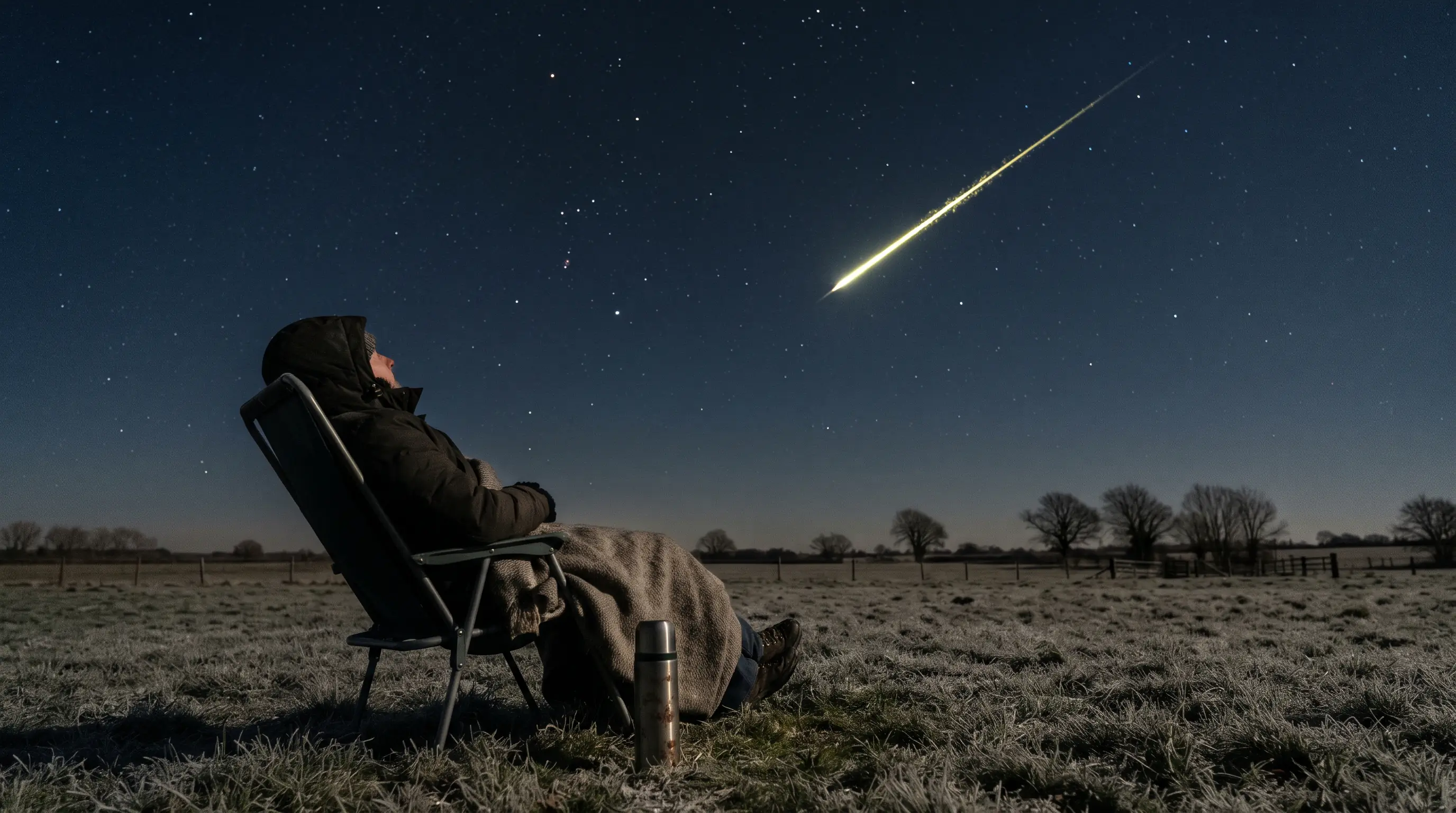
Bright yellow-green Geminid meteors radiating from the constellation Gemini above a frosty winter horizon, showing why Geminids come from asteroid Phaethon debris

The Geminids are the one major shower with good activity before midnight, with Gemini well placed from about 22:00 local time.

The Geminid stream traces to 3200 Phaethon, a rocky near-Earth object that sheds debris, rather than to an icy comet, and its orbit swings closer to the Sun than Mercury does.[1][2] Whether "asteroid" is the right label is still argued over, because Phaethon brightens like a comet near the Sun and some astronomers think it is a dead comet, a plain rock, or something between the two.[3] The practical result for a December watcher is a shower of dense rock with a zenithal hourly rate of 150, which is a ceiling and not a promise.[4]
Perihelion distance
0.14 AU
Within about 15 solar diameters of the Sun[5]
Geminid meteoroid density
2-3 g/cm³
Several times denser than cometary dust at 0.3[6]
Gemini well placed from
22:00
The one major shower with good activity before midnight[7]

How a rock became the Geminids' parent

Phaethon surfaced in a spacecraft's archive, not at an eyepiece: Green and Davies, combing infrared survey frames from the IRAS satellite for anything that moved, picked it out on 11 October 1983.[8] Charles Kowal's optical confirmation, announced three days later, reported it as asteroidal in appearance, a sharp point of light rather than a comet's fuzzy coma.[9] Fred Whipple then recognized the new object as the source of the Geminid meteors, which gave the shower a parent long before anyone could explain how a rock sheds debris.[10]
The object is small and extreme. NASA's page gives about 5.1 km across,[10] JPL's 2021 release about 5.8 km,[2] and Arecibo radar shows more than 6 km at the equator,[28] so published sizes run from about 5 to 6 km. Its 524-day orbit carries it inside Mercury's orbit to 0.14 AU, roughly 15 solar diameters from the Sun, where the surface reaches roughly 750 °C.[2][5]
So the first argument for an asteroid parent rested on appearance and orbit, not on any measurement of what Phaethon is made of. Most showers have a comet behind them, as Comet Tempel-Tuttle stood behind the 1833 Leonid meteor storm, and the Geminids stood out because their parent looked nothing like one. Chemistry came later and made the picture less tidy.

The rock comet that fizzes sodium

Phaethon looks least like an asteroid at the moment it is hottest. In June 2009, David Jewitt and Jing Li caught it brightening near perihelion in images from NASA's STEREO-A spacecraft and blamed dust ejected as surface rock broke down in heat of up to about 1,000 K, the origin of the rock comet idea.[11] They also pointed out that Phaethon is too hot for water ice to survive, which rules out the usual engine of a comet's outflow.[12]
The dust interpretation did not last. SOHO filters sensitive to sodium picked up the tail while the dust filter saw nothing, so the tail is gas, not dust.[13] Joseph Masiero, a scientist at Caltech's IPAC, and colleagues argued that sodium venting through cracks in the baked surface could be the push that lifts rocky grains off a body with very weak gravity, and it would explain why Geminid meteors contain little sodium.[14]
What Phaethon is made of is the next argument. A Nature Astronomy study by Eric MacLennan and Mikael Granvik matched its mid-infrared spectrum to Yamato-group (CY) carbonaceous chondrites, whose sulfides and carbonates release gas near 700 °C, and concluded that thermal decomposition could drive the activity.[17] I would treat that match as one proposal rather than an identification: it is a leading idea, not a settled one.

A breakup thousands of years ago may explain the stream
The sodium story has a size problem. Parker Solar Probe observations of the Geminid trail found far more mass than Phaethon's close passes could supply.[16] A 2023 dynamical study by Wolf Cukier and Jamey Szalay found that the stream's position relative to Phaethon's orbit fits a catastrophic formation event better than cometary outgassing.[18]
A gentler version comes from Hangbin Jo and Masateru Ishiguro, whose 2024 simulation built a Geminid-like stream from a low-velocity ejection, provided the grains left more than 2,000 years ago.[19] Two other Apollo asteroids, 2005 UD and 1999 YC, travel on orbits similar to Phaethon's, which suggests the pieces share a breakup.[20]
Milky Way over the red sandstone mountains of Wadi Rum, Jordan's UNESCO-listed desert stargazing destination

Featured · Destination

Wadi Rum

See the Wadi Rum night sky from a Zalabieh Bedouin camp in Jordan's UNESCO desert: bare tents to glass domes, Bortle 2-3 skies, and year-round stargazing.

That leaves the label as a description of the present. If the stream is ancient debris, Phaethon today is a mostly quiet rock that vents sodium when it is roasted, and 'asteroid' fits what is left; whether it began as a comet is a question JAXA's own science news site still asks openly.[3] The test is a flyby: DESTINY+ is due to pass Phaethon in Japanese fiscal year 2030,[21] and the original mission plan had it closing to roughly 500 km while the asteroid was about 150 million km from the Sun.[22]

What a rocky parent changes in the sky
Density is the practical difference from a comet shower. Geminid meteoroids run 2 to 3 g/cm³, several times denser than the 0.3 g/cm³ of cometary dust flakes, which fits grains broken from rock rather than shed by ice.[6]
Combined with a medium-slow entry speed of 35 km/s, that produces bright, intensely colored meteors that rarely leave the persistent trains faster showers do.[23][4] Like every shower on the meteor showers guide calendar, it has a zenithal hourly rate that is a ceiling for a radiant overhead under a perfect sky, so dark rural skies commonly average about 40 to 50 meteors per hour, against a theoretical 120 to 150[4] under ideal zenith conditions.[26] Southern Hemisphere viewers see lower rates, mainly around the middle of the night.[29]
The stream is also younger as a spectacle than as an object. The Geminids first appeared in records in the mid-1800s at only 10 to 20 meteors an hour,[24] and planetary gravity, Jupiter's especially, keeps reshaping the stream's orbit.
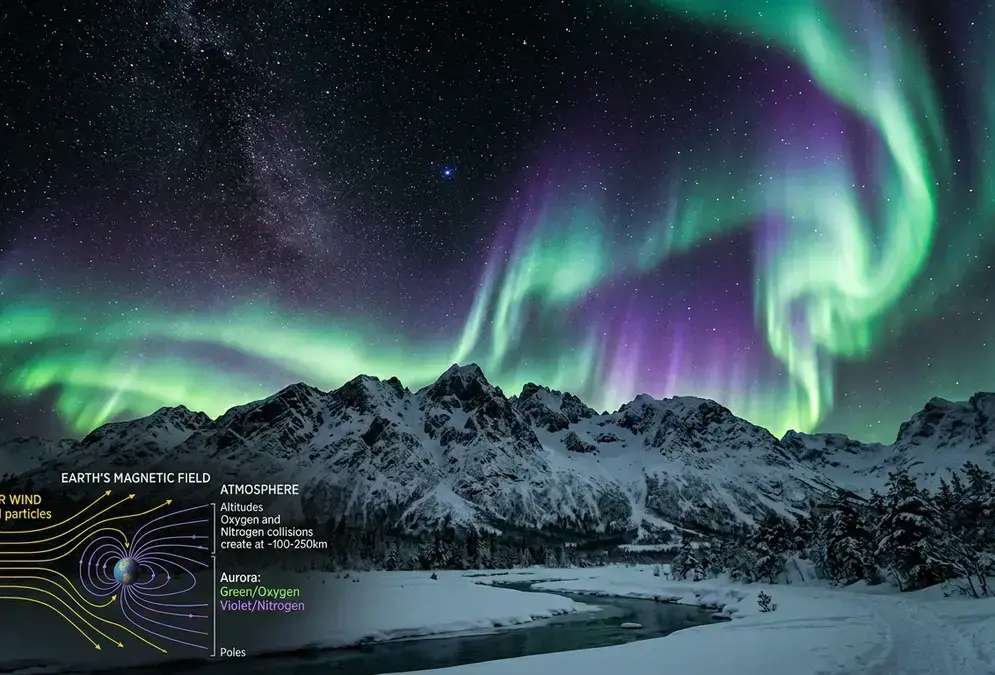
Green and violet auroral curtains rippling above a snow-covered mountain silhouette at night, illustrating what causes the northern lights through solar wind particles colliding with Earth's upper atmosphere.

Featured · Article

What Causes the Northern Lights? The Science Explained

Solar wind collides with Earth's magnetic field, funneling charged particles toward the poles, where they excite oxygen and nitrogen into glowing color.

The Geminids are not alone. The January Quadrantids are listed with an asteroid parent, 2003 EH1, and a ZHR of 120.[25] For a watcher, though, December has the advantage, because the Geminid radiant is up in the evening.

How to plan the night around a rock stream

Go out in the evening, not at 3 a.m. The Geminids are the one major shower with good activity before midnight, because Gemini is well placed from about 22:00 local time onward, so a normal bedtime still catches the shower.[7]
The peak falls in mid-December, around 13-14 December,[7] and the maximum is broad, nearly 24 hours, with the best viewing across the night and predawn hours, and the shower is visible worldwide.[26] That is the forgiving part: if the nominal peak night is clouded out, the nights either side still give a real shower, so I would pick the clearest forecast inside that window over the headline date.
  • Keep a spare night either side of the peak, since the maximum is broad.
  • Check the Moon phase for your year on the Geminid meteor shower event page, which also carries the exact peak hours; a bright Moon hides the fainter meteors.
  • Be at your site by about 22:00 local time so your eyes adapt while the radiant climbs.
  • Lie back with a view of as much sky as possible; the meteors appear anywhere, not only near Gemini.
  • Pick the darkest site you can reach, and start with the best dark sky parks in the world.

Recommended tours

Tours are selected for quality, not commission. I earn a small fee if you book — at no extra cost to you.

Whatever Phaethon turns out to be, the dense grains it left behind arrive on schedule every December, and this plan does not depend on the answer.

Frequently asked questions

Why do the Geminids come from an asteroid, and is Phaethon really one?

The Geminids' parent is listed as the asteroid 3200 Phaethon, which looked asteroidal rather than comet-like when it was confirmed in 1983.[1][9] The label is contested, since Phaethon brightens near the Sun and researchers still ask whether it was always an asteroid or a comet that lost its ices.[3]

How big is 3200 Phaethon and how long is its orbit?

NASA's page gives about 5.1 km across,[10] JPL's 2021 release about 5.8 km,[2] and Arecibo radar shows more than 6 km at the equator,[28] so published sizes run from about 5 to 6 km. It completes an elongated orbit in 524 days, passing inside the orbit of Mercury.[2]

How can a rocky asteroid produce a meteor shower?

Two proposals compete. One says sodium vaporizing through cracks in the heated surface lifts grains off the low-gravity body,[14] and the other says a breakup long ago laid down the stream.[18][19] Neither is settled.

Are Geminid meteors different from comet showers?

Yes. The grains are several times denser than cometary dust,[6] and the meteors are bright and intensely colored with few persistent trains.[23]

Are the Geminids the only meteor shower linked to an asteroid?

No. The January Quadrantids are listed with the asteroid 2003 EH1 as their parent object.[25]

Why are the Geminids better to watch before midnight than other showers?

Gemini is well placed from about 22:00 local time, which gives the Geminids good activity before midnight, unlike most major showers.[7]

When will a spacecraft visit Phaethon?

Under JAXA's current plan, DESTINY+ launches in Japanese fiscal year 2028 and flies past Phaethon in fiscal year 2030.[27][21]

Sources

29 references Show
  1. science.nasa.gov (opens in a new tab)

    “Unlike most meteor showers which originate from comets, the Geminids originate from an asteroid: 3200 Phaethon. Asteroid 3200 Phaethon takes 1.4 years to orbit the Sun once.”

  2. jpl.nasa.gov (opens in a new tab)

    “Phaethon’s elongated, 524-day orbit takes the object well within the orbit of Mercury, during which time the Sun heats the asteroid’s surface up to about 1,390 degrees Fahrenheit (750 degrees Celsius).”

  3. cosmos.isas.jaxa.jp (opens in a new tab)

    “Has Phaethon always been an asteroid, was it once a comet whose ices have long since sublimated away, or perhaps Phaethon is link to understand the relation between these two classes of small bodies?”

  4. amsmeteors.org (opens in a new tab)

    “Shower details - Radiant: 07:28 +33° - ZHR: 150 - Velocity: 22 miles/sec (medium - 35km/sec) - Parent Object: 3200 Phaethon (asteroid)”

  5. faculty.epss.ucla.edu (opens in a new tab)

    “It has a highly elliptical orbit that brings it to within 0.14 AU (about 15 solar diameters) of the Sun at perihelion.”

  6. science.nasa.gov (opens in a new tab)

    “Also, the bits and pieces (2-3 gm/cc) that break off to form the Geminid meteoroids are also several times denser than cometary dust flakes (0.3 gm/cc).”

  7. amsmeteors.org (opens in a new tab)

    “This is the one major shower that provides good activity prior to midnight as the constellation of Gemini is well placed from 22:00 onward.”

  8. Wikipedia (opens in a new tab)

    “Simon F. Green and John K. Davies discovered it in images from October 11, 1983, while searching Infrared Astronomical Satellite (IRAS) data for moving objects.”

  9. Wikipedia (opens in a new tab)

    “It was formally announced on October 14 in IAUC 3878 along with optical confirmation by Charles T. Kowal, who reported it to be asteroidal in appearance.”

  10. science.nasa.gov (opens in a new tab)

    “Phaethon is a small asteroid – its diameter measures only 3.17 miles (5.10 kilometers) across. It was astronomer Fred Whipple who realized that Phaethon is the source of the Geminid meteors.”

  11. faculty.epss.ucla.edu (opens in a new tab)

    “The most likely explanation is that Phaethon ejected dust, perhaps in response to break-down of the surface rocks in the intense (up to 1000 K) heat of the Sun.”

  12. faculty.epss.ucla.edu (opens in a new tab)

    “An impact origin of the dust is highly unlikely and Phaethon is too hot for water ice to survive, rendering unlikely the possibility that dust is ejected through gas-drag from sublimated ice.”

  13. NASA (opens in a new tab)

    “In SOHO’s observations, the asteroid’s tail appeared bright in the filter that detects sodium, but it did not appear in the filter that detects dust.”

  14. jpl.nasa.gov (opens in a new tab)

    “So the fizzing sodium could explain not only the asteroid’s cometlike brightening, but also how the Geminid meteoroids would be ejected from the asteroid and why they contain little sodium.”

  15. arxiv.org — 2303.17625 (opens in a new tab)

    “Color imaging by the SOHO LASCO coronagraphs during the 2022 May apparition indicate that the observed brightening and tail development instead capture the release of sodium atoms, which resonantly fluoresce at the 589.0/589.6 nm D lines.”

  16. NASA (opens in a new tab)

    “Observations from NASA’s Parker Solar Probe showed that the trail contained far more material than Phaethon could possibly shed during its close approaches to the Sun.”

  17. arxiv.org — 2207.08968 (opens in a new tab)

    “All of these lines of evidence are strong indicators that gas release from thermal decomposition reactions is responsible for Phaethon's activity.”

  18. arxiv.org — 2306.11151 (opens in a new tab)

    “Data-model comparisons of the location of the stream relative to Phaethon's orbit are more consistent with a catastrophic formation scenario, in contrast to cometary formation.”

  19. arxiv.org — 2401.03682v1 (opens in a new tab)

    “We found that the low-velocity ejection model produced the Geminid-like meteoroid stream when the dust particles were ejected more than 2,000 years ago.”

  20. Wikipedia (opens in a new tab)

    “The Apollo asteroids (155140) 2005 UD and (225416) 1999 YC share similar orbits with Phaethon, suggesting a possible common breakup origin.”

  21. destiny.isas.jaxa.jp (opens in a new tab)

    “In the revised trajectory, DESTINY+ will first fly by the asteroid Apophis—a topic of recent interest due to its close approach to Earth on Friday, April 13, 2029 (UT)—and then proceed to fly by Phaethon in fiscal year 2030.”

  22. dlr.de (opens in a new tab)

    “During its flyby the spacecraft will approach the asteroid down to a distance of approximately 500 kilometres, at which point the asteroid itself will be approximately 150 million kilometres from the Sun.”

  23. amsmeteors.org (opens in a new tab)

    “The Geminids are often bright and intensely colored. Due to their medium-slow velocity, persistent trains are not usually seen.”

  24. science.nasa.gov (opens in a new tab)

    “The Geminids first began appearing in the mid-1800s. However, the first showers were not noteworthy with only 10 to 20 meteors seen per hour.”

  25. amsmeteors.org (opens in a new tab)

    “Shower details - Radiant: 15:20 +49° - ZHR: 120 - Velocity: 25 miles/sec (medium - 40.4km/sec) - Parent Object: 2003 EH (Asteroid)”

  26. science.nasa.gov (opens in a new tab)

    “The Geminids are best viewed during the night and predawn hours and are visible across the globe due to a nearly 24-hour broad maximum.”

  27. destiny.isas.jaxa.jp (opens in a new tab)

    “The current plan is to launch in fiscal year 2028 as a rideshare with the European Space Agency’s (ESA) RAMSES spacecraft.”

  28. arxiv.org — 1902.00969 (opens in a new tab)

    “reveal a roughly spheroidal shape more than 6 km in diameter at the equator”

  29. amsmeteors.org (opens in a new tab)

    “These meteors are also seen in the Southern Hemisphere, but only during the middle of the night and at a reduced rate.”