All articles
Written by Maya Okonkwo
  • 5 min
  • 18 sources

Merzouga in December: Is the Sahara Too Cold for Kids at Night?

December nights near Erg Chebbi average 7 to 8°C, and one dataset logged −1°C. Here is what that means for kids at a desert camp and what to ask first.
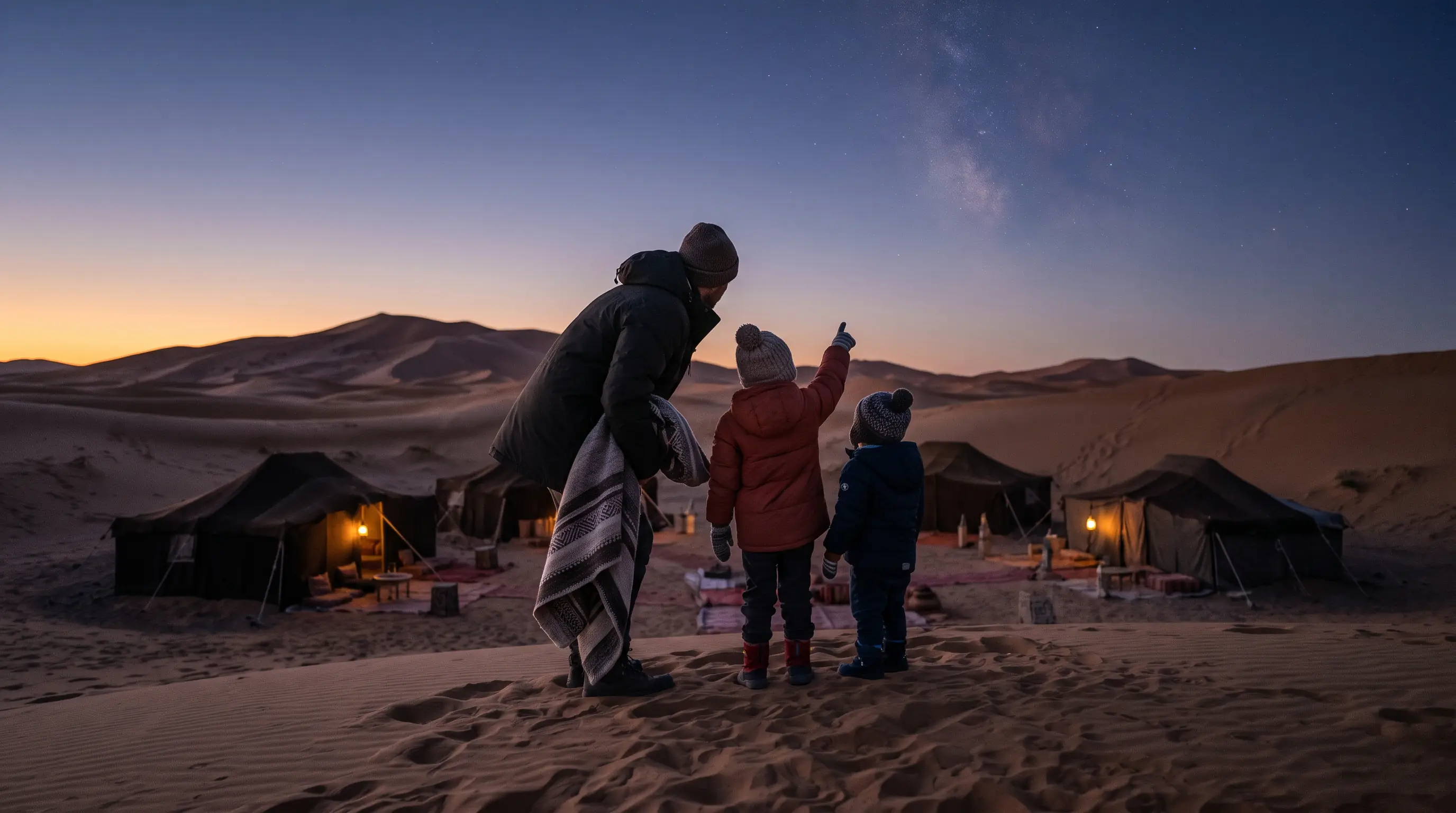
Parents and kids in warm winter layers at a Merzouga desert camp in December, looking up at a starry sky over Erg Chebbi dunes on a cold night

December nights near Erg Chebbi average about 7 to 8°C in two climate datasets, cold enough that young children need a plan.

Not categorically: December nights near Erg Chebbi average about 7 to 8°C in two climate datasets[1][2], cold enough that young children need a plan but not cold enough to rule out the trip for a family with layers and a warm place to retreat. The cases that change the answer are infants, children with medical vulnerabilities and any camp that cannot tell you how it heats its tents. If a camp cannot confirm that in writing, book a room and keep the stargazing to short outings.
December night average
7°C
Estimated Merzouga night average; days reach 20°C[1]
Possible December low
−1°C
One dataset lists about −1°C; not a forecast[3]
Average December sunset
18:15
Around 18:15 local time; full darkness comes later[4]

How cold Erg Chebbi gets after dark in December

A typical December night near Erg Chebbi sits around 7°C, after daytime highs near 20°C[1], a gap of roughly 13 degrees between the average daytime high and the average overnight low. A second dataset gives a 17°C high and an 8°C low[2], so a fair planning range is 7 to 8°C, with colder nights possible.
The first two are third-party climate estimates rather than a forecast for the dune where your camp sits. A third provider, Climate-Data.org, shows the same cooling from November into December and a December high near 17°C, but a lower December low of about 5°C[5], so providers differ by a few degrees. Read the seasonal temperature swings as a cooling trend into winter, and plan around night lows in the single digits and daytime highs of roughly 17 to 20°C. The second dataset, Where and When, also lists December wind averaging 11 km/h[18], a monthly figure rather than a reading for a cold night on a dune, so check the forecast, wind included, in the days before you fly. Dress for the overnight low, not the afternoon high, and treat the low end of that range as the night you will actually need every layer you packed.

Why small children feel the cold sooner than adults

US pediatric guidance, written for cold weather in general and not for Morocco, is clear on the physiology. Young children lose heat quicker than adults because of their body surface area relative to size[6], and hypothermia can occur more quickly in children, especially when clothing is inadequate or wet[7]. A child can go from fine to cold faster than the adult holding their hand.

Hypothermia means a body temperature below 35°C[8], so it describes the child rather than the weather; it is not an outdoor temperature at which a trip becomes unsafe. In a baby, NHS 111 Wales lists signs that are easy to miss:

  • cold to the touch
  • floppy
  • unusually quiet and sleepy, and possibly refusing feeds[9]
A child who can't tell you they are cold will show it by going quiet, so watch behavior as well as the thermometer. Keep spare dry layers within reach, because wet clothing raises the risk.

What to confirm with a camp before you book

Heating is the variable no climate table can supply, and I can't tell you how any particular camp warms its tents; only the operator can. A luxury label alone doesn't establish heating, so ask for answers in writing:

  • Is the exact tent or room you are booking heated all night, and how is the heat powered?
  • Are blankets provided, and is there a safe sleep surface for an infant?
  • Can a vehicle take you out, and how quickly can you reach a warm indoor space?
  • Who do you call at night, and which local emergency numbers apply?
Sleep needs its own question for babies. The American Academy of Pediatrics says to keep blankets, quilts, pillows and other loose bedding out of an infant's sleep space, using sleep clothing or a wearable blanket instead[10], and to place the baby on their back on a firm, flat surface for every nap and at night[11]. A camp's pile of heavy blankets is therefore not the answer for an infant.
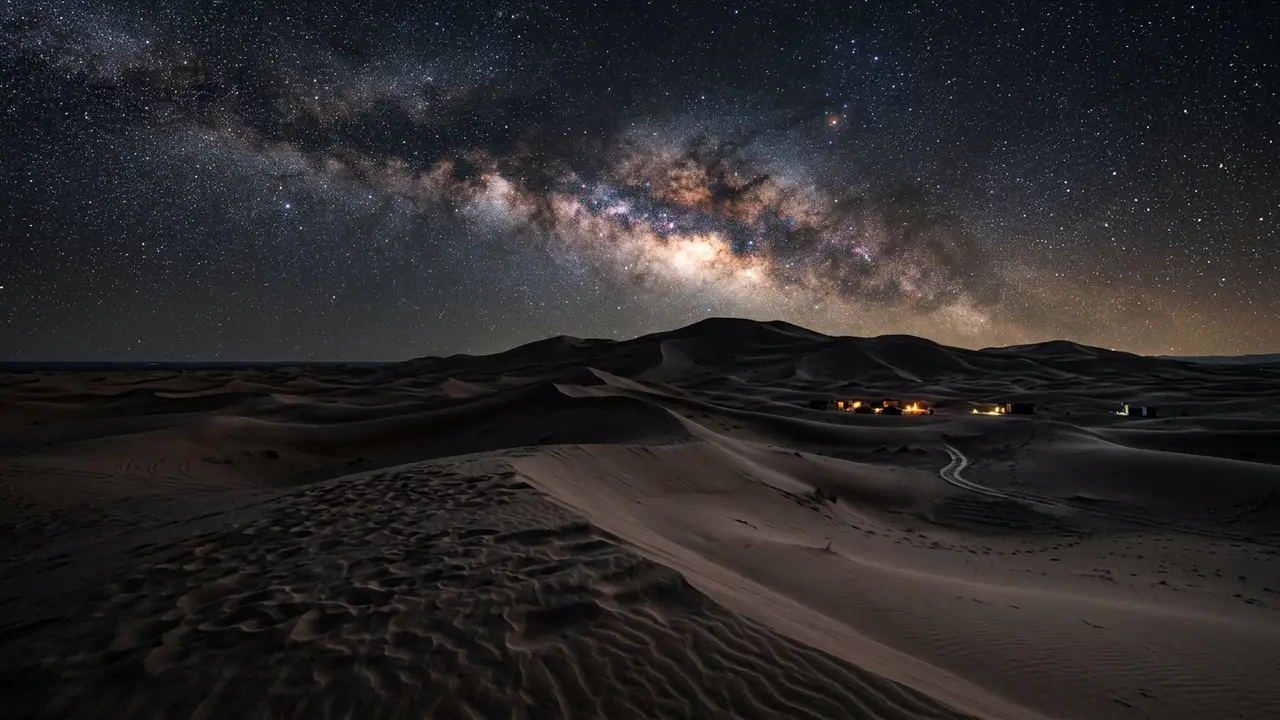
Milky Way rising over the sand dunes of Erg Chebbi near Merzouga, Morocco's Sahara Desert at night

Featured · Destination

Merzouga Stargazing

Erg Chebbi's dunes rise 150m above Morocco's Sahara, hours from city light. Stargaze from Berber-led desert camps: when to go, where to stay, how to get there.

Work out the journey too, because getting to Merzouga decides whether you reach camp before sunset or after dark with tired children. A camp that answers vaguely on warmth is worth treating with the same caution you would apply to any Merzouga desert tour.

A realistic December evening with young children
Sunset falls around 18:15 on an average December day, with sunrise near 08:07[4], but full darkness comes later, so the first stretch after sunset is twilight rather than a Milky Way. That gap argues for short, flexible outings: step out when the sky is ready and come back in when anyone is cold, rather than waiting outside for it.
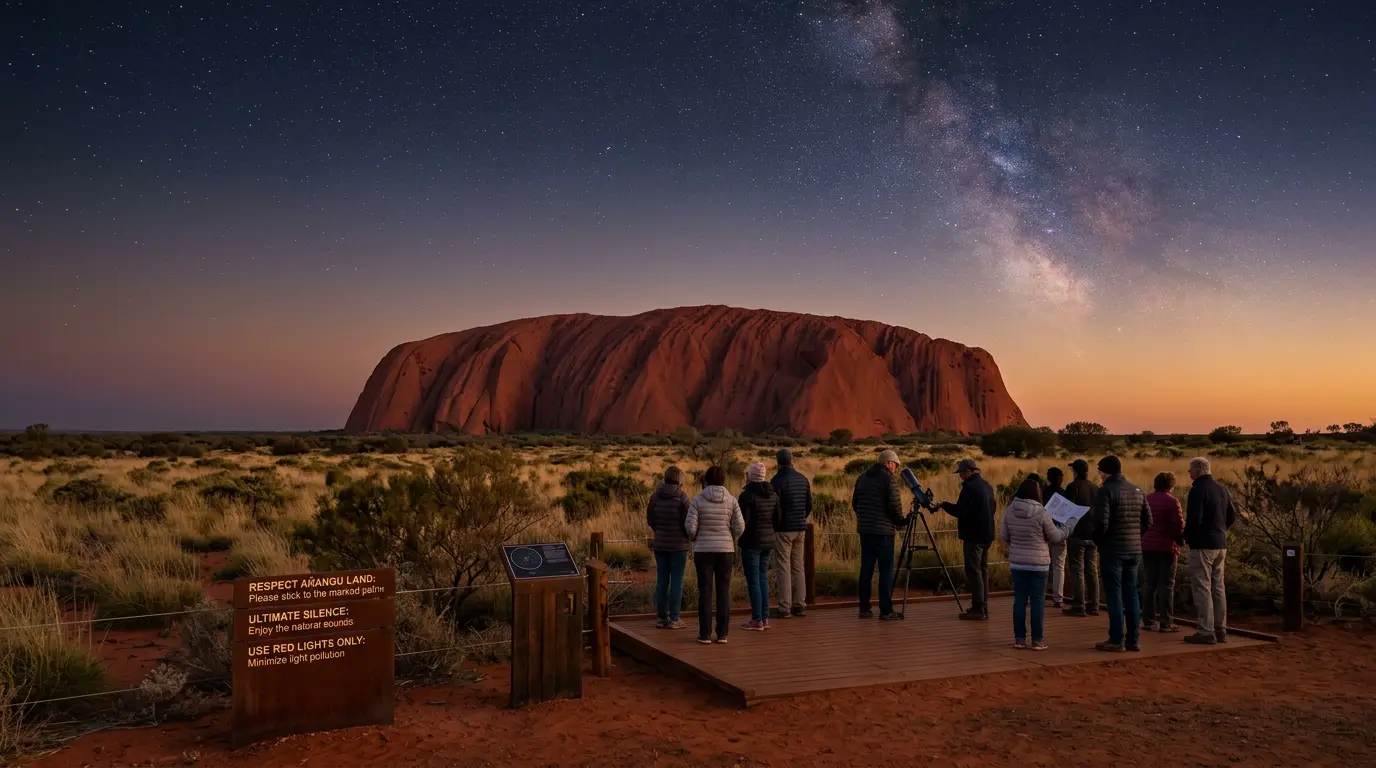
Wide, respectful photograph of Uluru glowing red at dusk under a star-filled sky on Anangu land, capturing Uluru's cultural significance and the visitor etiquette every stargazer should know

Featured · Article

Uluru Cultural Significance and Visitor Etiquette

Uluru is Anangu land under joint management. Here's why the 2019 climb closure is settled policy, what you can't photograph, and real visitor etiquette.

Dress children in several thin layers with warm boots, gloves or mittens and a hat[12], plus one more layer than an adult would wear in the same conditions[13]. Start from the Merzouga desert stargazing packing list and scale it for children, with a spare dry set.
Children's National says children can still play outdoors with proper gear as long as they come inside occasionally to warm up[14], which is the practical case for a camp with a warm tent or lounge a few steps from where you stand. I'd plan for short outings with a warm-up between them. There is no verified universal minimum age, outing length or temperature cutoff for stargazing with young children, so comfort, wind and your pediatrician's advice set the limit.

When a room is the better call than a tent

If warmth, safe sleep or quick access to care can't be guaranteed, a heated room is the better call, and postponing is better than either. That applies to babies and to any child with a medical vulnerability, where the pediatrician sets the terms, not a travel site. December isn't categorically unsafe for children; it is a month where the cold deserves a plan. A tent only wins the comparison when the operator can show you warmth, a safe sleep surface and a quick way back indoors; without those, a room costs little extra and removes the question.
A room-based alternative sits beside the dunes: Riad Madu describes itself as a family kasbah located by the sea of dunes of Erg Chebbi, in the town of Hasilabied, Merzouga[15]. Ask it the same heating and sleep questions you would ask a camp, since a room is not automatically warm. From a room, stargazing becomes an outing you choose rather than the whole evening.

Recommended tours

Tours are selected for quality, not commission. I earn a small fee if you book — at no extra cost to you.
The best stargazing spots in Merzouga are worth weighing against how far each is from where you sleep, since distance to a warm room decides how long a child can stay out. Before you travel, arrange and verify local emergency contacts; the 999 in NHS guidance is the UK number, not Morocco's. If you suspect hypothermia, move the child indoors or somewhere sheltered as quickly as possible and get urgent medical help[16].

Frequently asked questions

Is Merzouga too cold for kids in December?

Not categorically. December nights average about 7 to 8°C in two climate datasets[1][2], which calls for layers and a warm place to retreat rather than ruling the trip out. Infants and children with medical vulnerabilities are the exceptions worth a pediatrician's opinion first.

How cold does Merzouga get at night in December?

Averages sit around 7°C in one dataset[1] and 8°C in another[2]. A third provider puts the December low nearer 5°C[5]. A freeze is possible but not typical: one dataset lists a December low near −1°C[3], and Errachidia, a different location in the region, sees its coldest December nights drop to around 0°C[17]. Treat all of it as an estimate and check the forecast before you leave.

Can a toddler stargaze in the Sahara in December?

There is no verified minimum age, outing length or temperature cutoff. Short outings in layers, with a warm space close by and regular warm-ups[14], suit most toddlers better than one long session. Let the child's comfort and your pediatrician guide the decision.

Are Merzouga desert tents heated all night?

It depends on the camp and the tent category, and a luxury label does not settle it. Ask the operator whether your exact tent is heated all night, how the heat is powered and whether blankets are provided, and get the answer in writing.

What should children wear for a winter desert evening?

The American Academy of Pediatrics recommends several thin layers, warm boots, gloves or mittens and a hat[12], and one more layer than an adult would wear in the same conditions[13]. Pack a spare dry set, because wet clothing raises the risk of hypothermia[7].

Can a baby sleep safely in a desert camp?

Only if the camp can provide a firm, flat sleep surface and the baby sleeps on their back[11], without loose blankets, quilts or pillows in the sleep space[10]. If the camp cannot confirm a safe surface and reliable warmth, a heated room is the safer choice.

Can we see the stars early and sleep in a room near the dunes?

Yes, in principle. Sunset is around 18:15 in December, though full darkness comes later[4], so a room lets you step out for a short session and go back to a warm space. Riad Madu describes itself as a family kasbah by the Erg Chebbi dunes[15]; confirm heating with any room you consider.

Sources

18 references Show
  1. weather-and-climate.com (opens in a new tab)

    “Merzouga in December averages 20°C (68°F) during the day and 7°C (45°F) at night.”

  2. whereandwhen.net (opens in a new tab)

    “The average maximum temperature reaches 17°C, while the minimum falls to about 8°C.”

  3. weather-and-climate.com (opens in a new tab)

    “The coldest night in December in Merzouga was on December 31, 2016, with a minimum of -1°C (30°F).”

  4. whereandwhen.net (opens in a new tab)

    “In December, the days last on average 10:08 in Merzouga. The sun rises around 08:07 and sets around 18:15.”

  5. fr.climate-data.org (opens in a new tab)

    “| novembre | 15.7 | 9.3 | 21.7 | | décembre | 11.1 | 4.8 | 17.3 |”

  6. riseandshine.childrensnational.org (opens in a new tab)

    “Because of their size to skin ratio (body surface area), young children are prone to losing heat quicker than adults.”

  7. healthychildren.org — Cold Weather Safety (opens in a new tab)

    “It often happens when a child is playing outdoors in extremely cold weather without wearing proper clothing or when clothes get wet. It can occur more quickly in children than in adults.”

  8. 111.wales.nhs.uk (opens in a new tab)

    “Hypothermia is a dangerous drop in body temperature below 35C (normal body temperature is around 37C).”

  9. 111.wales.nhs.uk (opens in a new tab)

    “cold to touch - floppy - unusually quiet and sleepy and may refuse to feed”

  10. healthychildren.org — Cold Weather Safety (opens in a new tab)

    “Blankets, quilts, pillows, bumpers, sheepskins and other loose bedding should be kept out of an infant's sleeping environment.”

  11. healthychildren.org — A parents guide to safe sleep (opens in a new tab)

    “Place your baby on their back for all naps & at night.”

  12. healthychildren.org — Cold Weather Safety (opens in a new tab)

    “Several thin layers will keep them dry and warm. Always remember warm boots, gloves or mittens, and a hat.”

  13. healthychildren.org — Cold Weather Safety (opens in a new tab)

    “The rule of thumb for older babies and young children is to dress them in one more layer of clothing than an adult would wear in the same conditions.”

  14. riseandshine.childrensnational.org (opens in a new tab)

    “Children can still play outdoors as long as they have the proper safety gear and come inside occasionally to warm up.”

  15. riadmadu.com (opens in a new tab)

    “The Riad is a cosy family Kasbah, located by the sea of dunes of Erg Chebi, in the town of Hasilabied, Merzouga.”

  16. 111.wales.nhs.uk (opens in a new tab)

    “move the person indoors or somewhere sheltered as quickly as possible”

  17. climatestotravel.com (opens in a new tab)

    “On the coldest nights of the month, the temperature usually drops to around 0 °C. However, it dropped to -1.5 °C in December 2005.”

  18. whereandwhen.net (opens in a new tab)

    “| Wind speed | 13 km/h | | 11 km/h | | 12 km/h |”