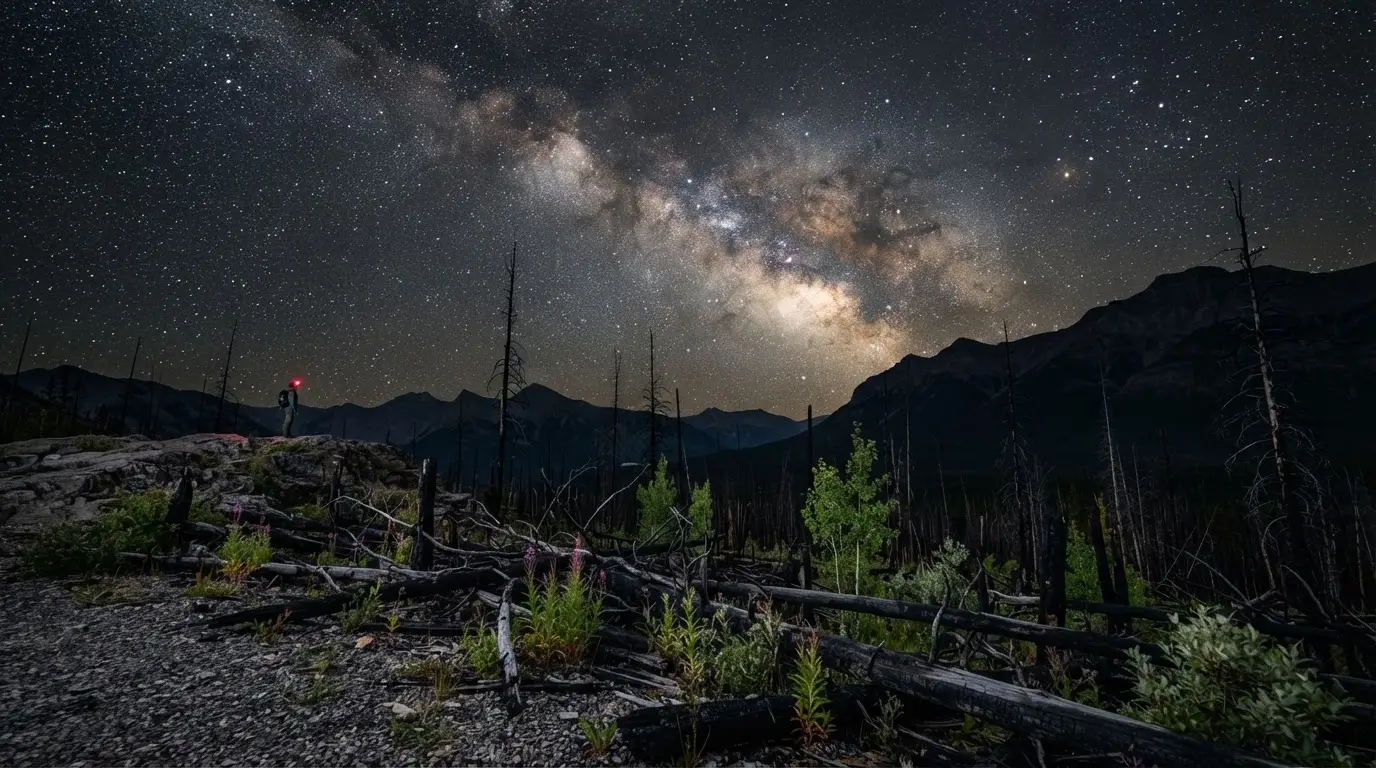

The Fire That Tested a Dark Sky Preserve
On July 22, 2024, two wildfires north and south of the resort town of Jasper merged and forced the evacuation of 25,000 residents, workers, and visitors[4]. The fire burned for six weeks before Parks Canada declared it under control on September 7, at a final mapped size of 32,722 hectares (80,860 acres)[1]; the largest wildfire recorded in the park in a century[6]. Of the 1,113 structures within the Jasper townsite, 358 were damaged or destroyed, though critical infrastructure including the hospital, schools, and wastewater treatment plant survived[5].
A wildfire of this scale inside a designated Dark Sky Preserve raises a question most dark-sky travelers have not had to ask before: does a burn scar change the stargazing? Jasper earned that designation in 2011 from the Royal Astronomical Society of Canada[9], and the classification measures light pollution and sky quality, not forest cover. No fire takes a Bortle rating off the books. But ground-level stargazing is a different thing from a preserved sky; it needs access roads, parking pullouts, and safe terrain, and those are exactly what the fire compromised.
Residents were allowed back into the townsite on August 16, 2024[13], and areas outside the townsite began reopening in stages starting with Miette Hot Springs on August 18. The fire was reclassified from "Under Control" to "Extinguished" on April 1, 2025[8], closing the official incident record and clearing the way for the recovery work that defines the 2026 season visitors are booking now.
358
Stargazing Spots After the Burn: What Reopened and When
The fire did not burn every trail and pullout evenly; it moved in a complex pattern that left some areas untouched and others closed for months of fire-danger assessment. By December 2024, the key night-access sites had reopened: Pyramid Bench, Old Fort Point, Lake Edith, Maligne Lake, and the Skyline Trail[2]. These are not just hiking destinations; they are the named dark-sky pullouts that appear on every stargazing itinerary for Jasper, and their December reopening meant the 2025 season started with the full stargazing map accessible again.
The sites that stayed open the longest, or reopened first, were those on the townsite's perimeter — Pyramid Bench and Old Fort Point especially, which sit close enough to Jasper's infrastructure that firefighting resources reached them early. Maligne Lake, deeper into the backcountry, took longer: the road was assessed for fire danger, hazard trees were cleared, and access returned before the winter snow locked things in.
One thing to keep in mind if you are stargazing on a burn-scarred landscape: the ground underfoot may be less stable than it looks. Tree roots that burned out underground leave cavities that can collapse under weight, and Parks Canada advises staying on marked trails and pullouts when the area was fire-affected. The official Jasper stargazing spots guide lists current access conditions for each viewing location, and it is worth checking before you commit to a given night's plan.
The Planetarium, the Festival, and What Is Fully Operational
The Jasper Planetarium operates out of a fixed building on the grounds of the Fairmont Jasper Park Lodge, well inside the townsite's defended perimeter. It was not damaged and is running its full 2026 schedule: open daily from May 1 through late October, then Wednesday through Saturday from December through April, excluding public holidays[10]. That means its dome theater and telescope courtyard are available throughout the entire Dark Sky Festival season.
The 2026 Jasper Dark Sky Festival runs October 16 through 25[3], its first edition since the 2024 cancellation. The program includes live music, speakers, family activities, and curated stargazing sessions; the full festival guide is at Jasper Dark Sky Festival, with booking links and programming details.
Featured · Destination
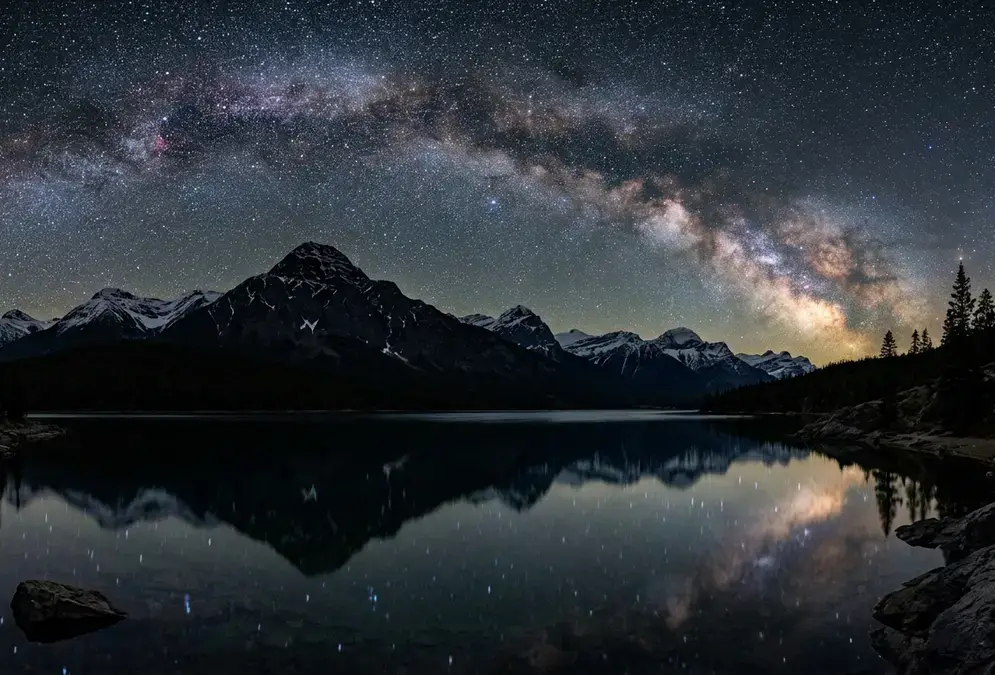
Stargazing in Jasper National Park
Jasper National Park is widely called the largest accessible Dark Sky Preserve in Canada: 11,228 km², an October Dark Sky Festival, and a 38-seat planetarium.
On accommodation: the majority of Jasper's hotels and lodges are open and have rooms available for visitors, according to Tourism Jasper's official recovery page[11]. The fuel stations, grocery stores, and restaurants in the townsite are operational. If you are driving in for a stargazing trip, plan your fuel stops normally; the park is not on reduced services, and the stretch of Highway 16 from Hinton to the townsite is fully open.
What the Burn Scar Looks Like After Dark
Driving through burned forest at night is a different experience from the same drive in daylight, and not one most dark-sky visitors have rehearsed. The visual field changes: where thick lodgepole pine once blocked the horizon, you now see bare ridgelines silhouetted against stars, the blackened trunks receding into a sky that reads larger than it did before the fire. This is a visitor-observation about sightlines, not a settled claim about sky quality; no published study has measured post-fire Bortle readings in Jasper, and anyone who tells you the burn made the sky darker is guessing.
What is measurable is that the burned terrain poses real hazards in the dark. The same root cavities and weakened soil that are a daytime concern become invisible after astronomical twilight. A red-light headlamp shows you the trail surface but not the structural integrity beneath it, and there is no substitute for staying on assessed routes. Parks Canada's trail-status page flags which sections remain on the assessed list, and the closure of Maligne Canyon and Cavell Road for the full 2026 season means those areas are off-limits day and night[14].
If you are new to stargazing in terrain with recent fire history, the stargazing for beginners guide covers dark adaptation and night safety; the practical takeaway is that a well-planned trip to the reopened pullouts gives you the same sky quality as before the fire, with fewer obstructions on the horizon and more reason to check trail conditions online the afternoon before you head out.
Helping Track the Recovery: Citizen Science on Old Fort Point
The most unusual thing a visitor can do in Jasper this season has nothing to do with telescopes. Parks Canada and the University of Waterloo have installed three photo stations along the Old Fort Point trail — a short, popular hike that starts minutes from the townsite — as part of a repeat-photography project (GeoReach) that tracks forest regeneration after the wildfire[12].
Each station is a fixed bracket at a marked viewpoint. You place your phone or camera on the bracket, frame the landscape, and take a photo from the same angle as every visitor before you. The images feed into a research dataset that lets ecologists measure regrowth across seasons and years: when the first green shoots appeared, how quickly the understory returned, which tree species recolonized first. You do not need to be a scientist, and you do not need special gear; a smartphone camera at a fixed bracket is the apparatus.
Featured · Article
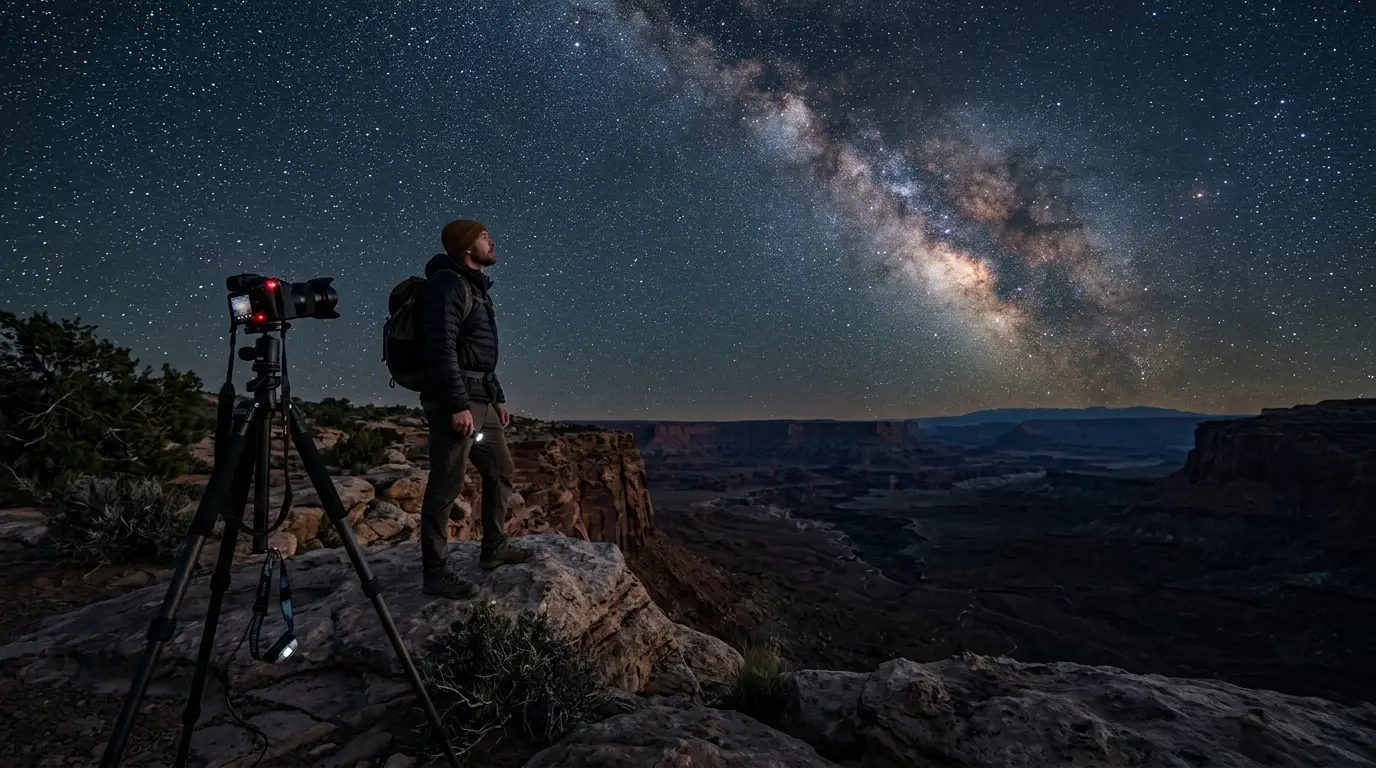
What Is Astrotourism? The Complete Beginner's Guide
Astrotourism means travel built around dark skies: meteor showers, auroras, the Milky Way. What it means, where to go, and how to plan your first trip.
This is not a short-term installation. The project is built for years of repeat visits, and the data it generates will inform how Parks Canada manages fire-affected terrain across the park. If you are already planning a trip around the Dark Sky Festival or a clear new-moon weekend, the photo stations add roughly 30 minutes to the Old Fort Point loop and cost nothing. The trail itself is one of Jasper's most reliable stargazing pullouts, so you can photograph the regrowth at dusk and set up for dark-sky viewing from the same parking area.
Planning a 2026 Visit Around the Recovery and the Skies
A Jasper stargazing trip in 2026 is closer to normal than most visitors expect. The preserve designation is unchanged, the key dark-sky pullouts are accessible, the planetarium is running a full season, and the Dark Sky Festival returns in October with a 10-day program. The differences from a pre-fire trip are two things: some trails remain closed for rehabilitation (notably Maligne Canyon and Cavell Road), and the burn-scarred landscape asks for more caution after dark than a visitor to an untouched forest would need.
The timing that gives you the best shot at clear, moonless skies has not changed: October, during the new moon, is the sweet spot. The Dark Sky Festival is deliberately scheduled across the new-moon window, and October in Jasper means temperatures around freezing at night, cold enough to keep bug activity down and sky transparency high, not cold enough to make standing outside for an hour a misery if you dress for it. The best time to stargaze guide breaks down moon-phase calendars and seasonal cloud-cover data across dark-sky destinations worldwide, including what to expect in Jasper by month.
Recommended tours
Tours are selected for quality, not commission. I earn a small fee if you book — at no extra cost to you.
If you are deciding whether the trip is worth it after the fire, the honest answer is that the sky quality is undiminished and the infrastructure is largely rebuilt, and the is Jasper worth it for stargazing piece walks through the full cost-to-sky-quality calculus. For visiting logistics, the Jasper destination page maps every bookable lodge, tour, and dark-sky pullout against the current access conditions.
The thing the fire added, rather than took away, is the chance to see a landscape in active recovery and to participate in tracking it. For a visitor who cares about dark-sky places as living ecosystems rather than static viewing platforms, that is a rare kind of trip, and one that did not exist before the summer of 2024.