The Antikythera Mechanism: Ancient Greece's Eclipse Computer

I've seen dark skies firsthand in the Atacama altiplano, Namibia's NamibRand Nature Reserve, and Morocco's Merzouga dunes; every other destination I write about is built from measured Bortle and SQM data, cloud climatology, and primary sources like park services and the International Dark-Sky Association.
In this article
Jump to a section
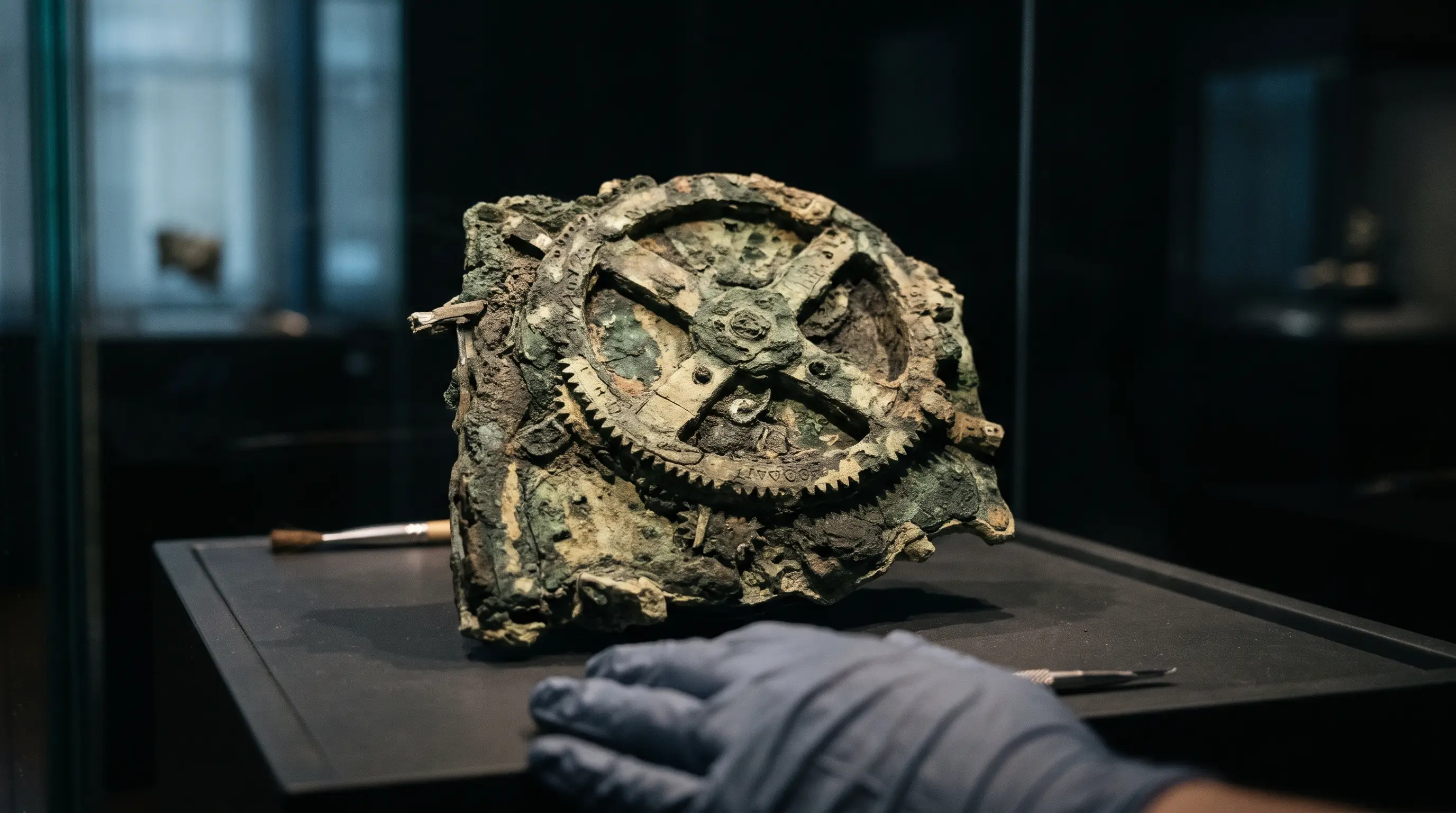
A bronze lump that turned out to be a machine
How the Saros dial turns months into eclipses
Studies of the dial show it could report four things about each eclipse[10]:
- the timing of the eclipse
- the amount of obscuration
- the angular diameter of the Moon
- the position of the Moon at that moment
0, 8, 16 hours
Who built it, and how accurate was it

Featured · Destination
Wadi Rum
See the Wadi Rum night sky from a Zalabieh Bedouin camp in Jordan's UNESCO desert: bare tents to glass domes, Bortle 2-3 skies, and year-round stargazing.
How Saros links one eclipse to the next

Featured · Article
What Causes the Northern Lights? The Science Explained
Solar wind collides with Earth's magnetic field, funneling charged particles toward the poles, where they excite oxygen and nitrogen into glowing color.
Seeing the mechanism, and planning around the next eclipse
Recommended tours
Tours are selected for quality, not commission. I earn a small fee if you book — at no extra cost to you.




Frequently asked questions
What is the Antikythera mechanism?
Could the Antikythera mechanism predict eclipses?
How does Antikythera mechanism eclipse prediction work?
Who built the Antikythera mechanism?
How accurate was ancient eclipse prediction?
Where is the Antikythera mechanism now?
Sources
26 references Show Hide
- Britannica: Antikythera mechanism (opens in a new tab)
“Radiographic images revealed that the fragments contained 30 gear wheels, an unprecedented complexity for its time, not seen again until medieval cathedral clocks.”
- PLOS ONE: Calendars with Olympiad display and eclipse prediction on the Antikythera Mechanism (opens in a new tab)
“The ancient Greek astronomical calculating machine, known as the Antikythera Mechanism, predicted eclipses, based on the 223-lunar month Saros cycle.”
- NASA Eclipse: Saros (opens in a new tab)
“Because the Saros period is not equal to a whole number of days, its biggest drawback is that subsequent eclipses are visible from different parts of the globe.”
- Britannica: Antikythera mechanism (opens in a new tab)
“It was recovered in 1901 from a trading ship that sunk in the Mediterranean Sea near Antikythera.”
- Jones, Ancient Near East Today (opens in a new tab)
“Stais noticed gears and tiny engraved Greek lettering on the fragments, and within a few days it was realized with excitement that they were the remains of some kind of astronomical device.”
- PLOS ONE: Calendars with Olympiad display and eclipse prediction on the Antikythera Mechanism (opens in a new tab)
“its design was a highly ingenious fusion of ancient Babylonian and Greek mathematical astronomy.”
- Smithsonian Magazine (opens in a new tab)
“The eclipse prediction calendar, a dial on the back of the mechanism includes a solar eclipse that happened May 12, 205 B.C.”
- NASA Eclipse: Saros (opens in a new tab)
“One Saros is equal to 223 synodic months.”
- Smithsonian Magazine (opens in a new tab)
“The new date pushes the origin back 50 years or even a century, Markoff writes, and indicates that the math the mechanism uses to predict eclipses is Babylonian arithmetic, not Greek trigonometry.”
- Live Science (opens in a new tab)
“The Antikythera Mechanism could not only predict the timing of eclipses but also reveal characteristics of those eclipses, such as the amount of obscuration, the angular diameter of the moon (which is the angle covered by the diameter of the full moon) and the position of the moon at the time of the eclipse, the study found.”
- Nature Humanities and Social Sciences Communications (opens in a new tab)
“The dial is divided into three sectors, which show eclipse time additions of 0, 8 and 16 h and has a period of just over 54 years (three Saros cycles).”
- Smithsonian Magazine (opens in a new tab)
“But the device also includes an inscription that refers to an athletic competition held in Rhodes, the likely place of origin, experts told the Times.”
- Britannica: Antikythera mechanism (opens in a new tab)
“Dating back to 100 BCE, this device, sometimes called the first known computer, featured the earliest known scientific dials and scales.”
- NASA Eclipse: Saros (opens in a new tab)
“It was known to the Chaldeans as a period when lunar eclipses seem to repeat themselves, but the cycle is applicable to solar eclipses as well.”
- PLOS ONE: Calendars with Olympiad display and eclipse prediction on the Antikythera Mechanism (opens in a new tab)
“Eclipses are indicated on a four-turn spiral Saros Dial by glyphs, which describe type and time of eclipse and include alphabetical index letters, referring to solar eclipse inscriptions.”
- PLOS ONE: Calendars with Olympiad display and eclipse prediction on the Antikythera Mechanism (opens in a new tab)
“with a lunar rms error of 1.4 hours and a solar rms error of 1.9 hours, giving a total rms error of 1.7 hours.”
- Nature Humanities and Social Sciences Communications (opens in a new tab)
“forecasting not only the occurrence of an eclipse in a particular month but also the time-of-day of the eclipse in hours and characteristics of the eclipse, such as magnitude and colour.”
- PLOS ONE: Calendars with Olympiad display and eclipse prediction on the Antikythera Mechanism (opens in a new tab)
“The only matching date is FM1 at-204 May-12 (Table S5), when the mean Sun was at 46.75°: all the other dates are more than 10° wrong”
- PLOS ONE: Calendars with Olympiad display and eclipse prediction on the Antikythera Mechanism (opens in a new tab)
“it should not necessarily be inferred that the date of the Antikythera Mechanism is the same as the date for which the Saros Dial was designed.”
- PLOS ONE: Calendars with Olympiad display and eclipse prediction on the Antikythera Mechanism (opens in a new tab)
“This surprisingly early date for the Saros Dial has been suggested previously, using conflicting methods”
- Nature Humanities and Social Sciences Communications (opens in a new tab)
“A radical revision of this scheme has been proposed in Anastasiou et al.”
- NASA Eclipse: Saros (opens in a new tab)
“The periodicity and recurrence of eclipses is governed by the Saros cycle, a period of approximately 6,585.3 days (18 years 11 days 8 hours).”
- NASA Eclipse: Saros series 126 (opens in a new tab)
“09566 15 2026 Aug 12 17:47:06 75 329 T 0.8977 1.0386 65.2N 25.2W 26 294 02m18s”
- NASA Eclipse: Saros series 136 (opens in a new tab)
“09568 02 2027 Aug 02 10:07:50 76 341 T 0.1421 1.0790 25.5N 33.2E 82 258 06m23s”
- NASA Eclipse: Saros series 136 (opens in a new tab)
“09528 01 2009 Jul 22 02:36:25 66 118 T 0.0698 1.0799 24.2N 144.1E 86 258 06m39s”
- Jones, Ancient Near East Today (opens in a new tab)
“The 82 known fragments as displayed currently in the National Archeological Museum, Athens.”